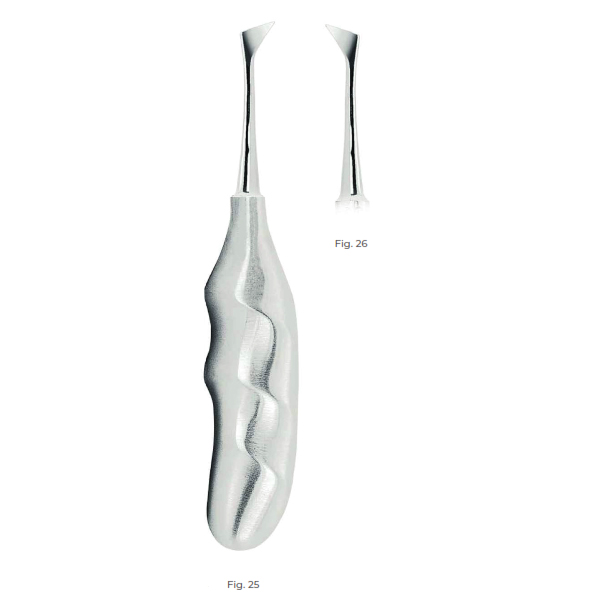
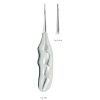
When a root fractures at the furcation or leaves behind a stubborn fragment, dental practitioners need an elevator shaped for that exact angle of access. The Cryer root elevator answers that need with a pointed, triangular-cross-section tip that wedges into narrow spaces, so root fragments lift out with minimal bone trauma.
An Anatomic Handle That Reduces Fatigue
Its anatomically contoured handle also distributes pressure evenly across the palm, which reduces hand fatigue during longer procedures. Because Fig. 25 is a standard reference size in the Cryer left/right pair, practitioners often use it alongside its mirror-image counterpart for full-arch coverage, similar to how the Schmeckebier-Apexo Fig. 4 SA and Fig. 5 SA elevators complement each other.
Specifications
| Attribute | Detail |
|---|---|
| Length | Approx. 17.5 cm |
| Material | AISI 420 stainless steel |
| Handle type | Anatomically contoured, hollow/lightweight grip |
| Blade type/angle | Cryer pattern, pointed triangular tip for mesial/distal root elevation |
| Finish | Satin/matte surgical finish |
| Sterilization method | Autoclavable (steam sterilization, 134°C standard cycle) |
| Reusable/Disposable | Reusable |
| Country of manufacture | Pakistan |
| Certification | CE marked; manufactured under ISO 13485-compliant quality processes |
Clinical Applications
- Elevation of mesial and distal root fragments after crown or root fracture
- Removal of retained root tips following incomplete extraction
- Sectioned root removal during surgical extraction of multi-rooted teeth
- Preparatory luxation before third molar (wisdom tooth) extraction
- Interproximal root elevation in cases of periodontally compromised teeth
Key Benefits
- The anatomic handle design reduces grip fatigue, especially during extended procedures
- Because it’s built from AISI 420 stainless steel, it resists corrosion across repeated autoclave cycles
- The pointed Cryer tip allows precise engagement in narrow interproximal spaces where broader elevators can’t reach
- Since it’s reusable, it supports long-term instrument cost efficiency versus disposable elevators
- It autoclaves reliably at standard 134°C cycles, so routine sterile reprocessing stays straightforward
Ideal For
General dental practices, oral and maxillofacial surgery clinics, dental teaching hospitals, and outpatient extraction suites.
Frequently asked questions
Yes, it autoclaves reliably using standard steam sterilization cycles at 134°C.
It’s reusable, so practitioners can sterilize and use it repeatedly rather than disposing of it after a single patient.
Fig. 25 typically pairs with a mirror-image counterpart to allow mesial and distal access on both sides of the arch; check your specific listing for whether it’s sold individually or as a pair.
It uses AISI 420 stainless steel, a standard grade for surgical instruments designed to withstand repeated autoclave cycles.
It’s manufactured in Pakistan and carries CE marking, produced under ISO 13485-compliant quality processes.

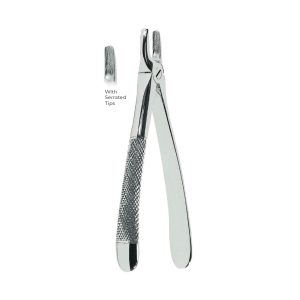
![Extracting Forceps Fig. 22 – Serrated Tips for Lower Molars – Precision Dental Extraction Instrument]](https://rheindental.com/wp-content/uploads/2024/12/RDJ-100-22-300x300.jpg)