
Orthodontics has evolved from a primitive practice of manually repositioning teeth into one of the most technologically advanced specialties in modern dentistry. Behind every successful orthodontic treatment lies a carefully designed set of orthodontic instruments that have continuously improved over centuries. Today, orthodontists rely on precision-engineered tools to diagnose, adjust, align, and maintain healthy smiles with remarkable accuracy and efficiency.
The evolution of orthodontic instruments reflects the remarkable progress of dental science, engineering, metallurgy, and digital technology. Ancient civilizations experimented with crude wire appliances, while today’s clinicians use ergonomic stainless steel instruments, nickel-titanium archwires, digital scanners, and CAD/CAM-designed appliances to achieve predictable treatment outcomes.
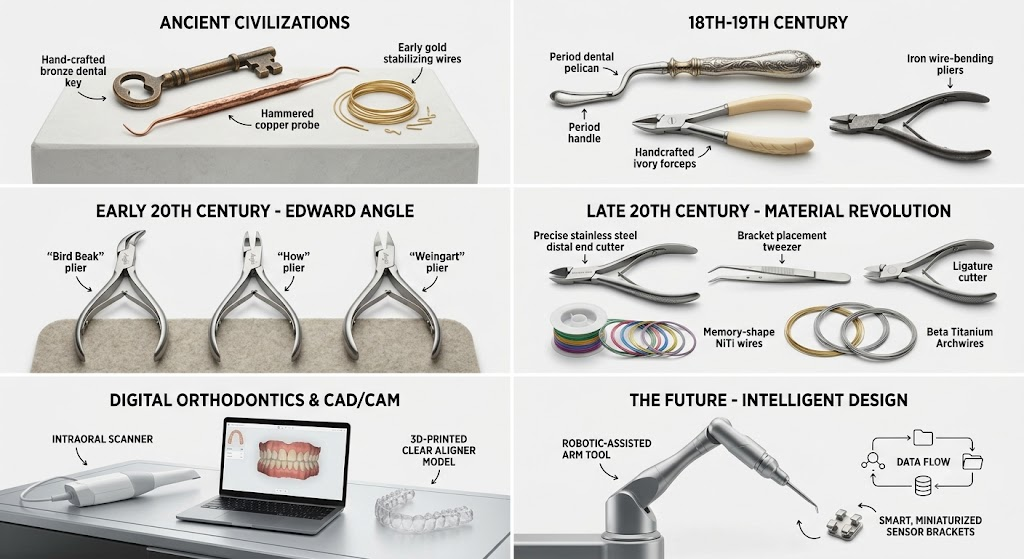
Understanding the history of orthodontic tools provides valuable insight into how innovation has improved patient comfort, treatment speed, infection control, and clinical precision. Whether you are a dental professional, orthodontic student, distributor, or manufacturer, exploring the journey of orthodontic instruments highlights the technological advancements that continue to shape modern orthodontics.
This comprehensive guide explores the complete evolution of orthodontic instruments—from ancient civilizations to today’s digital orthodontic era and explains how each innovation has transformed clinical practice.
Timeline of Orthodontic Instrument Evolution
| Period | Major Development | Common Orthodontic Tools |
|---|---|---|
| Ancient Egypt (3000–1000 BC) | Decorative gold wires for tooth stabilization | Gold wires, primitive bands |
| Ancient Greece (500–300 BC) | Early understanding of tooth alignment | Handcrafted dental tools |
| Roman Empire | Basic tooth movement concepts | Bronze and iron dental instruments |
| Middle Ages | Limited orthodontic progress | Simple extraction instruments |
| 18th Century | Birth of scientific dentistry | Dental pelicans, forceps |
| 19th Century | Orthodontics recognized as a specialty | Orthodontic pliers, bands, wires |
| Early 20th Century | Standardized orthodontic appliances | Wire bending pliers, ligature cutters |
| Late 20th Century | Stainless steel and nickel-titanium revolution | Precision pliers, bracket instruments |
| 21st Century | Digital orthodontics and clear aligners | Digital scanners, CAD/CAM systems, ergonomic instruments |
The Origins of Orthodontics: Ancient Civilizations
Long before orthodontics became a recognized dental specialty, ancient civilizations attempted to correct irregular teeth using surprisingly sophisticated methods for their time. Archaeological discoveries suggest that early societies understood the importance of dental appearance and experimented with methods to stabilize or reposition teeth.
Ancient Egypt (3000–1000 BC)
Ancient Egyptian mummies have revealed evidence of thin gold wires wrapped around individual teeth. Although researchers continue to debate whether these wires served cosmetic, ceremonial, or therapeutic purposes, they demonstrate one of the earliest known attempts to manipulate tooth positioning.
Dental practitioners of this era had limited instruments compared to modern standards. Their tools were handcrafted from bronze, copper, and precious metals, making procedures both challenging and imprecise.
Characteristics of early orthodontic tools included:
- Hand-forged metal wires
- Primitive tooth stabilization devices
- Bronze dental instruments
- Basic extraction tools
- Manual manipulation techniques
These early devices lacked the biomechanical principles that define modern orthodontics. Nevertheless, they established the foundation for future developments in dental instrument design.
Ancient Greece
Greek physicians introduced more scientific thinking into medicine, including dentistry. The renowned physician Hippocrates documented observations about dental irregularities and jaw development, emphasizing the relationship between oral anatomy and overall health.
Although specialized orthodontic instruments did not yet exist, practitioners began using improved hand instruments for examining and treating dental conditions. Their understanding of oral anatomy gradually influenced the design of dental tools.
Greek innovations contributed to:
- Improved dental examination methods
- Better understanding of tooth anatomy
- Development of specialized hand instruments
- Early concepts of jaw alignment
Roman Civilization
Roman physicians further expanded dental knowledge by developing more durable surgical instruments made from iron and bronze. Historical findings indicate that Roman dental practitioners used extraction forceps, probes, and various hand tools to manage oral diseases.
While orthodontic treatment remained extremely limited, Roman instrument craftsmanship significantly improved the durability and functionality of dental tools.
Notable advancements included:
- Stronger iron instruments
- Improved metalworking techniques
- More refined dental forceps
- Better surgical precision
These developments laid the groundwork for future generations of dental instrument manufacturers.
The Middle Ages: Limited Progress but Valuable Foundations
Following the decline of the Roman Empire, advancements in dentistry slowed considerably throughout the Middle Ages. Scientific research became less common, and dental care was often performed by barbers or general healers rather than trained specialists.
Most dental instruments during this period focused on tooth extraction rather than correction. Orthodontic treatment remained virtually nonexistent because the biological principles of tooth movement had not yet been understood.
Common dental instruments included:
- Tooth keys
- Dental pelicans
- Extraction forceps
- Simple scalpels
- Hand probes
Although innovation slowed, metalworking techniques continued to improve across Europe. These manufacturing advancements would later support the development of more specialized orthodontic instruments during the Renaissance.
Renaissance Dentistry: The Beginning of Scientific Dental Instruments
The Renaissance marked a turning point in medical science. Increased interest in anatomy, physiology, and surgical techniques led to significant improvements in dental care.
Dental practitioners began documenting treatment methods, while instrument makers produced more standardized surgical tools with improved ergonomics and functionality.
Important developments during this period included:
- Improved anatomical knowledge
- Better steel manufacturing
- Increased precision in handcrafted instruments
- More specialized dental equipment
- Enhanced surgical techniques
These innovations encouraged practitioners to explore methods beyond extraction, eventually leading to early orthodontic procedures.
Pierre Fauchard: The Father of Modern Dentistry
The history of orthodontic instruments cannot be discussed without recognizing Pierre Fauchard, whose groundbreaking work transformed dentistry into a scientific profession.
In 1728, Fauchard published Le Chirurgien Dentiste, one of the first comprehensive textbooks dedicated to dentistry. His work introduced innovative concepts for correcting irregular teeth using specially designed appliances.
One of his most influential inventions was the Bandeau, a horseshoe-shaped metal device used to expand dental arches and improve tooth alignment.
Fauchard’s contributions included:
- Scientific orthodontic treatment concepts
- Early orthodontic appliances
- Improved dental instruments
- Standardized treatment procedures
- Better documentation of dental techniques
His work established the foundation for modern orthodontics and inspired future generations of dental innovators.
The 19th Century: Birth of Modern Orthodontics
The nineteenth century witnessed extraordinary progress in orthodontics. For the first time, orthodontics emerged as a specialized branch of dentistry rather than a general dental procedure.
Dental professionals developed dedicated orthodontic instruments specifically designed for tooth movement instead of extraction.
Major innovations included:
Orthodontic Bands
Metal bands became widely used to anchor orthodontic appliances securely around teeth, allowing more controlled movement.
Wire Bending Instruments
Specialized pliers enabled orthodontists to shape archwires with greater precision, improving treatment accuracy.
Orthodontic Forceps
Forceps evolved beyond extraction, becoming essential tools for placing, adjusting, and removing orthodontic components.
Improved Impression Materials
More accurate impressions allowed practitioners to fabricate customized appliances with better fit and effectiveness.
These innovations significantly improved treatment predictability and patient outcomes.
Edward H. Angle and the Standardization of Orthodontic Instruments
No individual influenced the evolution of orthodontic instruments more profoundly than Edward H. Angle, often regarded as the father of modern orthodontics.
Angle revolutionized orthodontics by developing standardized classification systems for malocclusion and designing instruments specifically tailored for orthodontic procedures.
His contributions included:
- Standardized orthodontic pliers
- Precision wire-bending instruments
- Improved bracket systems
- Scientific treatment planning
- Specialized orthodontic education
The introduction of Angle’s appliance systems encouraged manufacturers to produce increasingly precise orthodontic instruments that remain influential today.
Early 20th Century: Precision Engineering Changes Orthodontics
The early twentieth century marked the beginning of precision manufacturing. Industrial advancements enabled companies to produce orthodontic instruments with consistent quality, superior ergonomics, and greater durability.
Stainless steel gradually replaced carbon steel, offering improved corrosion resistance and sterilization capabilities.
Orthodontists gained access to a growing range of specialized instruments, including:
- Bird Beak Pliers
- How Pliers
- Weingart Utility Pliers
- Distal End Cutters
- Ligature Cutters
- Bracket Placement Tweezers
- Mathieu Needle Holders
- Band Seating Instruments
- Wire Forming Pliers
These tools allowed clinicians to perform increasingly sophisticated orthodontic procedures while minimizing patient discomfort.
Moreover, standardized manufacturing ensured consistent instrument performance across practices worldwide, laying the foundation for the highly specialized orthodontic equipment used in modern clinics.
The late twentieth century marked one of the most significant periods in the evolution of orthodontic instruments. Rapid advancements in materials science, manufacturing technology, and clinical research transformed orthodontics from a largely manual specialty into a precision-driven field. Orthodontists gained access to stronger, lighter, and more ergonomic instruments that improved treatment efficiency while enhancing patient comfort.
Unlike earlier decades, when many orthodontic tools were handcrafted or minimally standardized, modern manufacturing introduced highly accurate production techniques. This ensured consistency in instrument quality, allowing clinicians around the world to rely on tools that delivered predictable performance.
Furthermore, innovations in metallurgy and biomechanics enabled manufacturers to develop instruments specifically designed for various stages of orthodontic treatment, from diagnosis and bracket placement to wire adjustment and appliance removal.
As a result, orthodontic procedures became more precise, treatment times decreased, and patient experiences improved significantly.
The Stainless Steel Revolution
One of the most important milestones in the history of orthodontic tools was the widespread adoption of medical-grade stainless steel. Before stainless steel became the industry standard, many dental instruments were made from carbon steel, which was prone to corrosion, staining, and reduced durability after repeated sterilization.
Stainless steel revolutionized orthodontic practice by offering exceptional strength, corrosion resistance, and longevity.
Why Stainless Steel Changed Orthodontics
Modern orthodontic instruments must withstand frequent sterilization cycles, exposure to moisture, and continuous clinical use. Stainless steel provided the ideal solution because it maintained its structural integrity even after thousands of sterilization procedures.
Key benefits included:
- Excellent corrosion resistance
- High tensile strength
- Long service life
- Easy sterilization in autoclaves
- Smooth surface finish for enhanced hygiene
- Reduced maintenance costs
- Consistent clinical performance
These characteristics made stainless steel the preferred material for manufacturing orthodontic pliers, forceps, wire cutters, bracket holders, and numerous other dental instruments.
Today, premium orthodontic instrument manufacturers continue to use high-quality surgical stainless steel because it offers an excellent balance of durability, precision, and cost-effectiveness.
Nickel-Titanium (NiTi): Transforming Orthodontic Wire Technology
Although stainless steel improved orthodontic instruments, one of the greatest breakthroughs in orthodontics came with the introduction of Nickel-Titanium (NiTi) archwires.
Developed using shape-memory alloy technology, NiTi wires possess unique properties that allow them to return to their original shape after bending. This characteristic enables the wire to deliver continuous, gentle forces that gradually move teeth into their desired positions.
Advantages of Nickel-Titanium Wires
Compared to traditional stainless steel wires, NiTi archwires offer several clinical advantages:
- Shape memory
- Superelasticity
- Continuous light forces
- Reduced patient discomfort
- Fewer wire adjustments
- Shorter appointment times
- Improved tooth movement efficiency
These innovations transformed early-stage orthodontic treatment by making tooth alignment more predictable and comfortable.
Moreover, NiTi wires reduced the frequency of orthodontic visits because they maintained consistent force over longer periods.
Titanium and Advanced Orthodontic Alloys
As research progressed, manufacturers introduced additional orthodontic materials designed to meet specialized clinical needs.
Today, orthodontists may choose from several advanced wire materials depending on treatment objectives.
Titanium Molybdenum Alloy (TMA)
Titanium Molybdenum Alloy combines flexibility with excellent formability, making it ideal for intermediate treatment stages.
Benefits include:
- Greater flexibility than stainless steel
- Easier wire bending
- Improved spring-back properties
- Enhanced control of tooth movement
Beta Titanium Wires
Beta titanium provides orthodontists with greater control during finishing stages while maintaining patient comfort.
Advantages include:
- Weldable material
- Excellent formability
- Moderate stiffness
- Biocompatibility
These advanced alloys expanded orthodontists’ treatment options and improved overall treatment precision.
The Evolution of Orthodontic Pliers
Orthodontic pliers have evolved dramatically over the past century. Earlier instruments often lacked ergonomic handles and precise working tips, making intricate procedures more difficult.
Modern orthodontic pliers are engineered for maximum control, accuracy, and clinician comfort.
Today’s orthodontic practices commonly use specialized pliers for specific procedures.
Bird Beak Pliers
Bird Beak Pliers remain among the most versatile orthodontic instruments. Their tapered tips enable clinicians to create loops, bends, and customized wire configurations with exceptional precision.
Common applications include:
- Loop formation
- Wire adjustments
- Appliance fabrication
- Retainer construction
Weingart Utility Pliers
Weingart Pliers are designed to securely grasp orthodontic wires without damaging their surface.
They are frequently used for:
- Archwire insertion
- Wire removal
- Appliance adjustments
- Ligature positioning
Distal End Cutters
Distal End Cutters allow orthodontists to trim excess archwire safely after placement.
Modern designs often include safety-hold mechanisms that capture the cut wire segment, reducing the risk of accidental ingestion or injury.
Benefits include:
- Increased patient safety
- Cleaner wire trimming
- Improved clinical efficiency
Ligature Cutters
Ligature cutters have become increasingly refined, enabling orthodontists to remove fine ligature wires with minimal effort and maximum precision.
Their sharp cutting edges reduce wire distortion while improving procedural accuracy.
Bracket Removing Pliers
As orthodontic bonding techniques advanced, specialized bracket removal instruments became essential.
Modern bracket-removing pliers are carefully designed to minimize stress on tooth enamel while safely detaching brackets.
Advantages include:
- Reduced enamel damage
- Comfortable bracket removal
- Improved operator control
Advancements in Orthodontic Forceps
Orthodontic forceps have also undergone significant improvements.
Earlier forceps primarily focused on tooth extraction, whereas modern orthodontic forceps are designed for delicate appliance manipulation.
Today’s forceps assist clinicians with:
- Band placement
- Band removal
- Elastic separator placement
- Appliance adjustments
- Orthodontic attachment handling
Precision tips and ergonomic grips enhance clinician control while reducing hand fatigue during lengthy procedures.
Brackets and Bonding Instruments
The development of orthodontic brackets revolutionized tooth movement, but equally important was the evolution of the instruments used to place them.
Modern bonding instruments provide exceptional accuracy when positioning brackets on tooth surfaces.
Common bonding instruments include:
- Bracket positioning tweezers
- Bracket placement gauges
- Composite placement instruments
- Adhesive applicators
- Bracket holding forceps
Accurate bracket placement significantly influences treatment outcomes because even small positioning errors can affect tooth movement.
Consequently, manufacturers continue refining bonding instruments to maximize placement precision.
Digital Orthodontics: A Technological Revolution
Perhaps no advancement has transformed orthodontics more than the emergence of digital orthodontics.
Digital technologies have reshaped diagnosis, treatment planning, appliance fabrication, and patient communication.
Instead of relying solely on traditional impressions and manual measurements, orthodontists now utilize sophisticated digital systems to create highly accurate virtual models of patients’ teeth.
Major benefits include:
- Increased diagnostic accuracy
- Faster treatment planning
- Reduced human error
- Improved patient education
- Better communication with dental laboratories
- Digital record storage
- Predictable treatment outcomes
Digital workflows have become standard in many orthodontic practices worldwide.
CAD/CAM Technology in Orthodontics
Computer-Aided Design (CAD) and Computer-Aided Manufacturing (CAM) have significantly enhanced the production of orthodontic appliances.
Using digital scans, orthodontists can design customized appliances that precisely fit each patient’s anatomy.
CAD/CAM technology is commonly used to fabricate:
- Clear aligners
- Orthodontic retainers
- Lingual appliances
- Indirect bonding trays
- Surgical guides
- Customized brackets
Benefits include:
- Exceptional precision
- Faster appliance production
- Reduced laboratory errors
- Better appliance fit
- Improved treatment efficiency
Customization has become one of the defining features of modern orthodontics, enabling clinicians to provide more personalized care.
Intraoral Scanners Replace Traditional Impressions
Traditional dental impressions using trays and impression materials were often uncomfortable for patients and susceptible to inaccuracies caused by bubbles, distortions, or movement.
The introduction of intraoral scanners has transformed this process.
These handheld digital devices capture thousands of images per second to create highly detailed three-dimensional models of a patient’s teeth and oral structures.
Advantages of Digital Intraoral Scanners
Compared with conventional impressions, digital scanning offers numerous benefits:
- Greater patient comfort
- Highly accurate digital models
- Faster appointment times
- Elimination of impression material distortions
- Instant digital file sharing with laboratories
- Improved treatment planning
- Enhanced patient communication through real-time visualization
Digital impressions have become a cornerstone of modern orthodontics, supporting both fixed appliance treatments and clear aligner therapy.
3D Printing: Revolutionizing Orthodontic Appliance Manufacturing
Another groundbreaking innovation in the evolution of orthodontic tools is 3D printing. This technology has changed how orthodontic appliances are designed, produced, and delivered.
Using digital models generated through intraoral scanners and CAD software, dental laboratories and clinics can manufacture highly accurate appliances with remarkable speed.
Today, 3D printing is commonly used to produce:
- Clear aligner models
- Orthodontic retainers
- Indirect bonding trays
- Surgical guides
- Custom appliance components
- Educational models for patient consultation
Benefits of 3D Printing in Orthodontics
The adoption of 3D printing has provided several advantages for clinicians and patients alike:
- Faster appliance production
- Improved manufacturing precision
- Reduced material waste
- Better customization for individual patients
- Lower long-term production costs
- Streamlined digital workflows
- Enhanced treatment efficiency
As digital dentistry continues to evolve, 3D printing is expected to play an even greater role in the future of orthodontic care.
Conclusion:
The late twentieth and early twenty-first centuries ushered in an era of remarkable innovation in orthodontics. From the introduction of stainless steel instruments and nickel-titanium archwires to the adoption of CAD/CAM systems, digital intraoral scanners, and 3D printing, orthodontic tools have become more precise, efficient, and patient-focused than ever before.
These advancements have not only improved clinical outcomes but have also transformed the way orthodontists diagnose, plan, and deliver treatment. As technology continues to advance, the integration of digital workflows and intelligent manufacturing is setting new standards for precision orthodontics.