
Introduction: Understanding Invisalign Orthodontic Tools
Clear aligner treatment has transformed modern orthodontics by offering patients a discreet alternative to traditional metal braces. Among the most recognized clear aligner systems, Invisalign uses advanced digital technology combined with specialized orthodontic instruments to move teeth gradually and accurately (Invisalign orthodontic tools).
However, successful Invisalign treatment does not depend only on the aligners themselves. Orthodontists rely on a complete ecosystem of Invisalign orthodontic tools, including digital scanners, treatment planning software, attachment placement instruments, aligner seating tools, and clinical accessories.
These tools allow dental professionals to:
- Capture accurate digital impressions
- Design customized treatment plans
- Place attachments precisely
- Monitor tooth movement
- Improve patient comfort
- Achieve predictable orthodontic outcomes
For dental clinics investing in clear aligner services, selecting the right orthodontic instruments for Invisalign treatment plays an important role in improving workflow efficiency and treatment quality.
What Are Invisalign Orthodontic Tools?
Invisalign orthodontic tools refer to the equipment, instruments, and digital technologies used throughout the clear aligner treatment process.
Unlike traditional braces that require brackets, wires, and ligatures, Invisalign treatment uses removable transparent aligners. Therefore, orthodontists need different tools focused on:
- Digital diagnosis
- Treatment simulation
- Aligner manufacturing
- Attachment placement
- Clinical adjustments
- Patient management
A modern Invisalign workflow combines:
| Category | Purpose | Examples |
|---|---|---|
| Digital tools | Create treatment plans | Intraoral scanners, 3D software |
| Clinical instruments | Modify and adjust aligners | Pliers, scissors, instruments |
| Attachment tools | Place tooth attachments | Attachment templates, placement tools |
| Patient accessories | Improve aligner use | Chewies, removal tools |
| Monitoring tools | Track progress | Digital monitoring systems |
Why Are Specialized Tools Important in Invisalign Treatment?
Although clear aligners appear simple, achieving accurate tooth movement requires careful planning and precise clinical execution.
According to orthodontic research, digital workflows can improve treatment planning accuracy by allowing clinicians to visualize expected tooth movement before starting treatment.
The right Invisalign tools help orthodontists:
1. Improve Treatment Accuracy
Digital scanning eliminates many problems associated with traditional impression materials, such as:
- Material distortion
- Patient discomfort
- Incorrect impressions
- Retakes
High-quality digital records allow orthodontists to design better treatment plans.
2. Increase Clinical Efficiency
Modern Invisalign workflows reduce chair time because dentists can:
- Review digital models before appointments
- Prepare attachments efficiently
- Standardize treatment procedures
- Track progress digitally
3. Improve Patient Experience
Patients often choose Invisalign because it offers:
- Better aesthetics
- Easier cleaning
- More comfortable orthodontic treatment
Using appropriate tools helps dentists maintain these advantages throughout treatment.
Complete List of Tools Used in Invisalign Treatment
1. Intraoral Scanner: The Foundation of Digital Invisalign Treatment
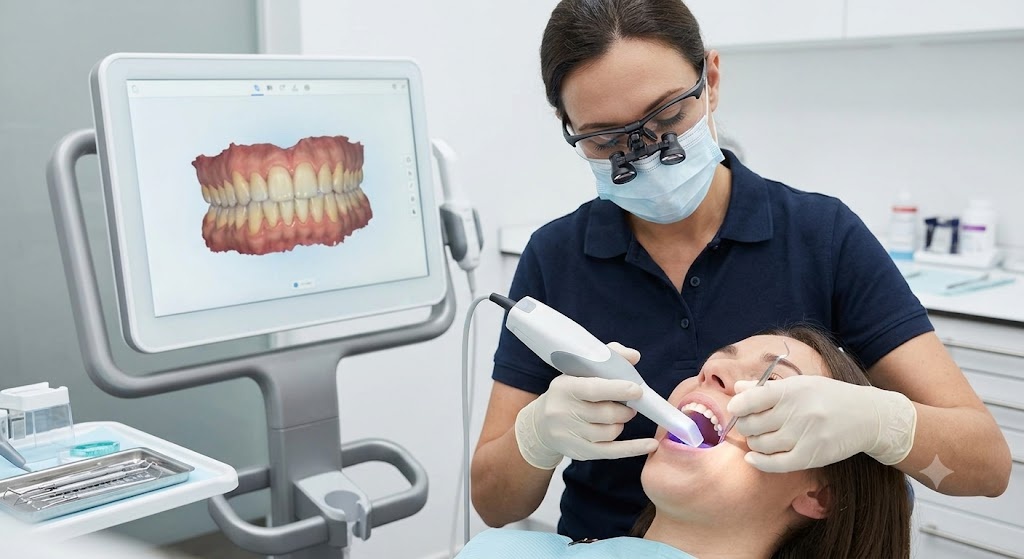
An intraoral scanner is one of the most important tools used in modern Invisalign workflows.
Instead of taking traditional dental impressions, dentists use a scanner to create a precise 3D digital model of the patient’s teeth.
Common Functions of Intraoral Scanners:
- Capture tooth anatomy
- Record bite relationship
- Create digital impressions
- Send data for aligner planning
- Monitor treatment progress
Benefits of Digital Scanning:
| Traditional Impression | Digital Scan |
|---|---|
| Uses impression material | Uses optical scanning technology |
| Can cause gag reflex | More comfortable for patients |
| Requires physical storage | Stored digitally |
| Higher risk of distortion | More consistent accuracy |
Popular Digital Scanning Systems:
- Align Technology iTero scanners
- 3Shape TRIOS scanners
- Medit intraoral scanners
For clinics offering Invisalign treatment, investing in digital scanning technology can improve workflow speed and patient communication.
2. Invisalign Treatment Planning Software
Digital treatment planning software allows orthodontists to simulate tooth movement before producing aligners.
The software creates a virtual representation of:
- Current tooth position
- Expected tooth movement
- Final smile outcome
- Number of aligners required
Key Features Include:
Virtual Treatment Simulation
Dentists can show patients:
- Starting dental condition
- Planned tooth movement
- Expected final result
This improves patient understanding and treatment acceptance.
Tooth Movement Analysis
The software helps clinicians evaluate:
- Crowding
- Spacing
- Rotation
- Intrusion
- Extrusion
- Bite correction
Treatment Customization
Orthodontists can modify:
- Movement speed
- Attachment requirements
- Aligner sequence
- Treatment stages
3. Attachment Placement Tools
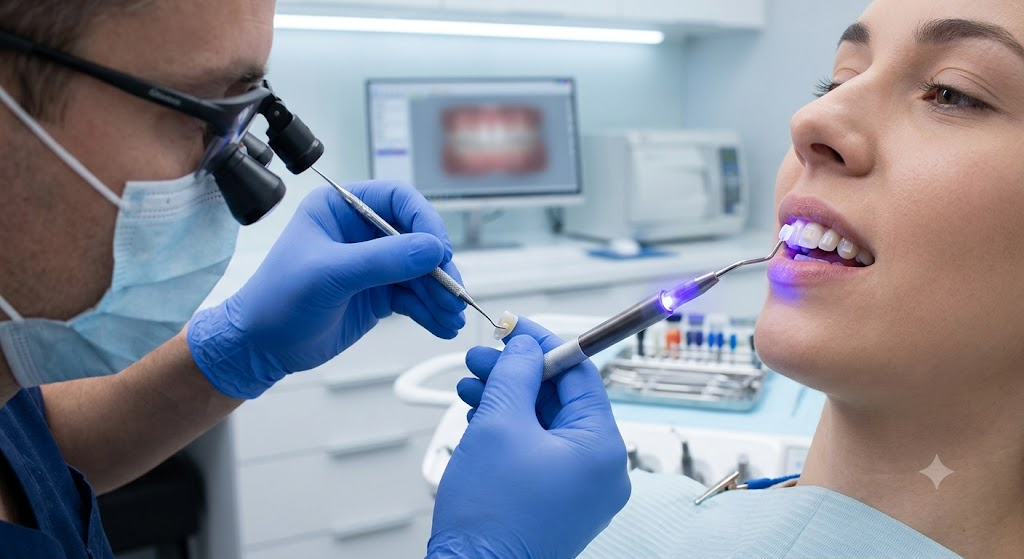
Attachments are small tooth-coloured composite shapes placed on teeth to improve aligner control.
They act as grip points that allow aligners to apply specific forces.
Tools Used for Invisalign Attachments:
Attachment Templates
Attachment templates help dentists accurately position composite attachments according to the treatment plan.
Composite Placement Instruments
Common instruments include:
- Composite placement spatulas
- Dental explorers
- Composite instruments
- Placement brushes
Benefits of Accurate Attachment Placement:
- Better tooth movement control
- Improved aligner fitting
- More predictable outcomes
- Reduced refinement cases
Clear aligners sometimes require minor modifications to improve comfort or movement control.
4. Invisalign Pliers and Aligner Adjustment Instruments
Specialized orthodontic pliers allow dentists to make precise adjustments.
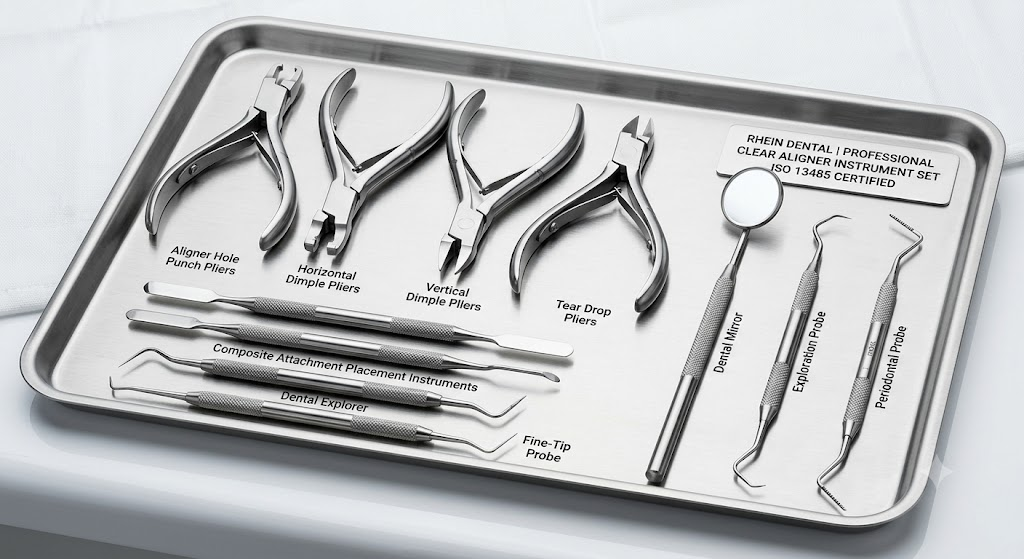
Common Invisalign Pliers:
| Instrument | Function |
|---|---|
| Aligner removal pliers | Help patients remove difficult aligners |
| Horizontal adjustment pliers | Create specific pressure points |
| Vertical adjustment pliers | Modify aligner contact |
| Hole punch pliers | Create space around attachments or buttons |
| Tear drop pliers | Improve aligner retention |
5. Aligner Removal Tools
Although Invisalign aligners are removable, some patients experience difficulty removing them, especially during the first few days of a new tray.
Aligner removal tools improve patient convenience.
Examples:
- Aligner removal hooks
- Clear aligner retrievers
- Orthodontic removal aids
Advantages:
- Reduces patient frustration
- Protects aligners from damage
- Helps elderly patients or patients with limited dexterity
6. Aligner Chewies
Aligner chewies are small cylindrical devices made from soft material.
Patients bite on chewies to help seat aligners properly.
Why Are Chewies Used?
They help:
- Improve aligner fit
- Remove air gaps
- Increase contact between teeth and aligner
- Encourage correct seating
A properly seated aligner improves the effectiveness of the programmed tooth movement.
7. Orthodontic Scissors and Cutting Instruments
Sometimes clear aligners require minor trimming or modification.
Dental professionals may use precision cutting instruments for:
- Removing sharp edges
- Adjusting aligner margins
- Improving patient comfort
Important characteristics include:
- Fine cutting edges
- Stainless steel construction
- Corrosion resistance
- Ergonomic handling
High-quality orthodontic instruments are commonly manufactured under quality management systems such as ISO 13485, which specifies requirements for medical device quality management systems.
8. Digital Photography Equipment
Clinical photographs remain an important part of orthodontic diagnosis and documentation.
Orthodontists commonly capture:
- Facial photographs
- Smile photographs
- Intraoral images
- Occlusion records
These records help with:
- Treatment planning
- Progress monitoring
- Patient communication
- Clinical documentation
Summary: Essential Invisalign Orthodontic Tools
| Tool | Main Purpose |
|---|---|
| Intraoral scanner | Digital impressions |
| Treatment planning software | Virtual tooth movement planning |
| Attachment tools | Precise attachment placement |
| Invisalign pliers | Aligner adjustments |
| Removal tools | Easier aligner handling |
| Chewies | Improve aligner seating |
| Orthodontic scissors | Minor aligner modifications |
| Digital cameras | Diagnosis and documentation |
Step-by-Step Invisalign Treatment Workflow and Tools Used at Each Stage of Orthodontic aligner instruments
A successful Invisalign treatment follows a structured digital and clinical workflow. Each stage requires specific orthodontic tools to ensure accuracy, efficiency, and predictable results (Invisalign orthodontic tools).
Step 1: Patient Consultation and Orthodontic Assessment
Before starting Invisalign treatment, orthodontists evaluate whether clear aligners are suitable for the patient.
Tools Used:
Digital Photography Equipment
Orthodontists capture:
- Facial photographs
- Smile photographs
- Intraoral photographs
- Occlusion views
These images help document:
- Tooth alignment
- Facial aesthetics
- Bite relationship
- Treatment progress
Dental Examination Instruments
Common diagnostic instruments include:
- Dental mirrors
- Explorers
- Periodontal probes
- Retractors
These instruments help assess:
- Tooth condition
- Gum health
- Existing restorations
- Oral hygiene status
Radiographic Equipment
X-rays may be required to evaluate:
- Root position
- Bone support
- Impacted teeth
- Jaw relationships
Common imaging methods include:
- Panoramic radiographs
- Cephalometric X-rays
- CBCT scans (when clinically required)
Step 2: Digital Scanning and Data Collection
Modern Invisalign treatment usually begins with a digital impression (Invisalign orthodontic tools).
Instead of traditional impression trays, many clinics use intraoral scanners.
Workflow:
- Dentist scans upper and lower arches
- Scanner records tooth surfaces
- Bite relationship is captured
- Digital model is created
- Data is transferred to treatment planning software
Benefits of Digital Scanning
| Feature | Traditional Impression | Digital Scan |
|---|---|---|
| Patient comfort | Lower | Higher |
| Storage | Physical models | Cloud/digital storage |
| Accuracy | Depends on material handling | High digital precision |
| Communication | Requires physical models | Easy sharing |
Step 3: Digital Treatment Planning
After scanning, orthodontists use specialized software to plan tooth movement.
The software helps create a virtual treatment simulation showing:
- Starting position
- Movement stages
- Final expected outcome
- Number of aligners required
Important Treatment Planning Features
1. Movement Control
Orthodontists can plan:
- Tooth rotation
- Expansion
- Crowding correction
- Space closure
- Bite improvements
2. Attachment Planning
The software determines:
- Attachment location
- Attachment size
- Attachment shape
- Required force direction
3. Patient Communication
Digital simulations allow dentists to explain:
- Why treatment is needed
- Expected results
- Treatment timeline
This improves patient confidence and acceptance.
Step 4: Aligner Production and Delivery
Once the treatment plan is approved, customized aligners are produced.
Each aligner is designed to move teeth gradually according to the planned sequence.
Tools Used During Aligner Delivery Appointment
Attachment Placement Instruments
Dentists may use:
- Composite placement instruments
- Dental explorers
- Attachment templates
- Light curing equipment
Interproximal Reduction (IPR) Instruments
Some Invisalign cases require small adjustments between teeth to create space.
Common IPR tools include:
- Dental strips
- Diamond discs
- Finishing strips
IPR should only be performed by trained dental professionals following proper clinical protocols.
Step 5: Aligner Fitting and Adjustment
During delivery, the orthodontist checks:
- Proper seating
- Patient comfort
- Attachment engagement
- Tooth tracking
Instruments Used:
Invisalign Pliers
These allow clinicians to make controlled adjustments.
Common types include:
| Instrument | Purpose |
|---|---|
| Horizontal adjustment pliers | Creates pressure areas |
| Vertical adjustment pliers | Improves tooth engagement |
| Hole punch pliers | Creates clearance areas |
| Tear drop pliers | Improves retention |
Aligner Seating Tools
Examples:
- Chewies
- Seating aids
They help patients ensure the aligner fits completely over the teeth.
Step 6: Monitoring Progress During Treatment
Regular monitoring ensures teeth are moving according to the treatment plan.
Appointments may include:
- Clinical examination
- Digital scans
- Photographic records
- Aligner fit evaluation
Digital Monitoring Tools
Modern orthodontic practices increasingly use:
- Remote monitoring platforms
- Smartphone-based tracking
- Digital communication systems
Benefits include:
- Fewer unnecessary visits
- Faster identification of problems
- Better patient compliance
Advanced Invisalign Orthodontic Tools Used in Modern Practices
1. 3D Printing Technology
3D printing has become an important technology in modern orthodontics.
It can be used for:
- Dental models
- Treatment planning models
- Retainer production
- Orthodontic appliances
Benefits of 3D Printing:
- Faster production
- Digital workflow integration
- Improved customization
- Reduced physical storage needs
2. Digital Smile Design Tools
Digital smile design technology helps clinicians evaluate how orthodontic treatment affects facial aesthetics.
It combines:
- Photography
- Digital models
- Treatment simulation
Advantages:
- Better patient communication
- Improved aesthetic planning
- More predictable outcomes
3. Dental Magnification and Loupes
Precision is extremely important during Invisalign procedures.
Dental loupes help clinicians:
- Improve visibility
- Place attachments accurately
- Perform detailed adjustments
4. Sterilization Equipment for Invisalign Instruments
Reusable orthodontic instruments must follow proper infection prevention protocols.
Common sterilization equipment includes:
- Ultrasonic cleaners
- Autoclaves
- Instrument cassettes
Dental instrument manufacturers commonly follow quality standards such as:
ISO 13485
ISO 13485 specifies requirements for a medical device quality management system.
It focuses on:
- Product consistency
- Risk management
- Manufacturing controls
- Documentation
CE Marking and EU MDR
For medical devices sold in the European market:
- CE marking indicates conformity with applicable European safety and performance requirements.
- EU Medical Device Regulation (MDR 2017/745) establishes stricter requirements for medical device safety, traceability, and clinical evaluation.
FDA Requirements
Dental instruments marketed in the United States may require compliance with relevant FDA regulations depending on product classification.
Invisalign Tools vs Traditional Braces Instruments Comparison
| Feature | Invisalign Tools | Traditional Braces Tools |
|---|---|---|
| Main appliance | Clear aligners | Brackets and wires |
| Planning method | Digital simulation | Physical adjustments |
| Key technology | Scanners and software | Mechanical orthodontic systems |
| Main instruments | Pliers, scanners, attachment tools | Bracket holders, wire cutters, ligature tools |
| Patient visibility | Nearly invisible | Visible |
| Removal | Patient removable | Fixed appliance |
Invisalign Treatment Tools: Pros and Cons Orthodontic aligner instruments
Advantages of Invisalign Orthodontic Tools
1. Digital Accuracy
Digital scanners and software provide detailed treatment planning.
2. Better Patient Experience
Patients benefit from:
- Comfortable procedures
- Fewer physical impressions
- Better aesthetics
3. Efficient Clinical Workflow
Digital systems allow:
- Faster communication
- Better documentation
- Easier treatment monitoring
4. Improved Treatment Visualization
Patients can understand their expected results before beginning treatment.
Limitations of Invisalign Orthodontic Tools
| Challenge | Explanation |
|---|---|
| Higher equipment investment | Digital scanners and software require investment |
| Training requirements | Dentists need clear aligner training |
| Patient compliance required | Aligners must be worn as instructed |
| Not suitable for every case | Complex cases may require alternative approaches |
Complete Invisalign Instrument Checklist for Dental Clinics
A clinic offering Invisalign treatment should consider maintaining the following equipment (Invisalign orthodontic tools):
Diagnostic Tools Checklist
✓ Digital camera system
✓ Intraoral scanner
✓ Dental mirrors
✓ Explorers
✓ Periodontal probes
✓ Retractors
Treatment Planning Checklist
✓ Digital treatment software
✓ Patient photography records
✓ Digital models
✓ Treatment simulation system
Clinical Procedure Checklist
✓ Attachment placement instruments
✓ Composite instruments
✓ Light curing unit
✓ Invisalign pliers
✓ Aligner removal tools
✓ IPR strips
✓ Chewies
Infection Control Checklist
✓ Autoclave
✓ Ultrasonic cleaner
✓ Instrument cassettes
✓ Sterilization pouches
Practical Clinical Tips for Better Invisalign Outcomes
Tip 1: Prioritize Accurate Digital Records
Poor-quality scans can affect treatment planning accuracy.
Always ensure:
- Complete arch capture
- Clear margins
- Correct bite registration
Tip 2: Focus on Attachment Accuracy
Attachments play a major role in controlling tooth movement.
Incorrect placement can reduce treatment effectiveness.
Tip 3: Educate Patients Properly
Patient compliance is essential.
Dentists should explain:
- Wearing time requirements
- Cleaning instructions
- Proper insertion and removal
- Storage methods
Tip 4: Maintain High-Quality Instruments Orthodontic aligner instruments
Premium orthodontic instruments provide:
- Better control
- Longer lifespan
- Improved clinical results
Look for instruments manufactured with:
- Surgical-grade stainless steel
- Corrosion resistance
- Precision finishing
- Quality control processes
EEAT Insight: Why Instrument Quality Matters in Invisalign Dentistry
Experienced orthodontic professionals understand that successful clear aligner treatment depends on more than digital technology.
The quality of clinical instruments directly affects:
- Attachment placement accuracy
- Patient comfort
- Treatment efficiency
- Long-term instrument reliability
Dental clinics should select suppliers that provide:
Clear aligner treatment has transformed modern orthodontics by offering patients a discreet alternative to traditional metal braces. Among the most recognized clear aligner systems, Invisalign uses advanced digital technology combined with specialized orthodontic instruments to move teeth gradually and accurately (Invisalign orthodontic tools).
However, successful Invisalign treatment does not depend only on the aligners themselves. Orthodontists rely on a complete ecosystem of Invisalign orthodontic tools, including digital scanners, treatment planning software, attachment placement instruments, aligner seating tools, and clinical accessories.
These tools allow dental professionals to:
- Capture accurate digital impressions
- Design customized treatment plans
- Place attachments precisely
- Monitor tooth movement
- Improve patient comfort
- Achieve predictable orthodontic outcomes
For dental clinics investing in clear aligner services, selecting the right orthodontic instruments for Invisalign treatment plays an important role in improving workflow efficiency and treatment quality.
What Are Invisalign Orthodontic Tools?
Invisalign orthodontic tools refer to the equipment, instruments, and digital technologies used throughout the clear aligner treatment process.
Unlike traditional braces that require brackets, wires, and ligatures, Invisalign treatment uses removable transparent aligners. Therefore, orthodontists need different tools focused on:
- Digital diagnosis
- Treatment simulation
- Aligner manufacturing
- Attachment placement
- Clinical adjustments
- Patient management
A modern Invisalign workflow combines:
| Category | Purpose | Examples |
|---|---|---|
| Digital tools | Create treatment plans | Intraoral scanners, 3D software |
| Clinical instruments | Modify and adjust aligners | Pliers, scissors, instruments |
| Attachment tools | Place tooth attachments | Attachment templates, placement tools |
| Patient accessories | Improve aligner use | Chewies, removal tools |
| Monitoring tools | Track progress | Digital monitoring systems |
Why Are Specialized Tools Important in Invisalign Treatment?
Although clear aligners appear simple, achieving accurate tooth movement requires careful planning and precise clinical execution.
According to orthodontic research, digital workflows can improve treatment planning accuracy by allowing clinicians to visualize expected tooth movement before starting treatment.
The right Invisalign tools help orthodontists:
1. Improve Treatment Accuracy
Digital scanning eliminates many problems associated with traditional impression materials, such as:
- Material distortion
- Patient discomfort
- Incorrect impressions
- Retakes
High-quality digital records allow orthodontists to design better treatment plans.
2. Increase Clinical Efficiency
Modern Invisalign workflows reduce chair time because dentists can:
- Review digital models before appointments
- Prepare attachments efficiently
- Standardize treatment procedures
- Track progress digitally
3. Improve Patient Experience
Patients often choose Invisalign because it offers:
- Better aesthetics
- Easier cleaning
- More comfortable orthodontic treatment
Using appropriate tools helps dentists maintain these advantages throughout treatment.
Complete List of Tools Used in Invisalign Treatment
1. Intraoral Scanner: The Foundation of Digital Invisalign Treatment
An intraoral scanner is one of the most important tools used in modern Invisalign workflows.
Instead of taking traditional dental impressions, dentists use a scanner to create a precise 3D digital model of the patient’s teeth.
Common Functions of Intraoral Scanners:
- Capture tooth anatomy
- Record bite relationship
- Create digital impressions
- Send data for aligner planning
- Monitor treatment progress
Benefits of Digital Scanning:
| Traditional Impression | Digital Scan |
|---|---|
| Uses impression material | Uses optical scanning technology |
| Can cause gag reflex | More comfortable for patients |
| Requires physical storage | Stored digitally |
| Higher risk of distortion | More consistent accuracy |
Popular Digital Scanning Systems:
- Align Technology iTero scanners
- 3Shape TRIOS scanners
- Medit intraoral scanners
For clinics offering Invisalign treatment, investing in digital scanning technology can improve workflow speed and patient communication.
2. Invisalign Treatment Planning Software
Digital treatment planning software allows orthodontists to simulate tooth movement before producing aligners.
The software creates a virtual representation of:
- Current tooth position
- Expected tooth movement
- Final smile outcome
- Number of aligners required
Key Features Include:
Virtual Treatment Simulation
Dentists can show patients:
- Starting dental condition
- Planned tooth movement
- Expected final result
This improves patient understanding and treatment acceptance.
Tooth Movement Analysis
The software helps clinicians evaluate:
- Crowding
- Spacing
- Rotation
- Intrusion
- Extrusion
- Bite correction
Treatment Customization
Orthodontists can modify:
- Movement speed
- Attachment requirements
- Aligner sequence
- Treatment stages
3. Attachment Placement Tools
Attachments are small tooth-coloured composite shapes placed on teeth to improve aligner control.
They act as grip points that allow aligners to apply specific forces.
Tools Used for Invisalign Attachments:
Attachment Templates
Attachment templates help dentists accurately position composite attachments according to the treatment plan.
Composite Placement Instruments
Common instruments include:
- Composite placement spatulas
- Dental explorers
- Composite instruments
- Placement brushes
Benefits of Accurate Attachment Placement:
- Better tooth movement control
- Improved aligner fitting
- More predictable outcomes
- Reduced refinement cases
Clear aligners sometimes require minor modifications to improve comfort or movement control.
4. Invisalign Pliers and Aligner Adjustment Instruments
Specialized orthodontic pliers allow dentists to make precise adjustments.
Common Invisalign Pliers:
| Instrument | Function |
|---|---|
| Aligner removal pliers | Help patients remove difficult aligners |
| Horizontal adjustment pliers | Create specific pressure points |
| Vertical adjustment pliers | Modify aligner contact |
| Hole punch pliers | Create space around attachments or buttons |
| Tear drop pliers | Improve aligner retention |
5. Aligner Removal Tools
Although Invisalign aligners are removable, some patients experience difficulty removing them, especially during the first few days of a new tray.
Aligner removal tools improve patient convenience.
Examples:
- Aligner removal hooks
- Clear aligner retrievers
- Orthodontic removal aids
Advantages:
- Reduces patient frustration
- Protects aligners from damage
- Helps elderly patients or patients with limited dexterity
6. Aligner Chewies
Aligner chewies are small cylindrical devices made from soft material.
Patients bite on chewies to help seat aligners properly.
Why Are Chewies Used?
They help:
- Improve aligner fit
- Remove air gaps
- Increase contact between teeth and aligner
- Encourage correct seating
A properly seated aligner improves the effectiveness of the programmed tooth movement.
7. Orthodontic Scissors and Cutting Instruments
Sometimes clear aligners require minor trimming or modification.
Dental professionals may use precision cutting instruments for:
- Removing sharp edges
- Adjusting aligner margins
- Improving patient comfort
Important characteristics include:
- Fine cutting edges
- Stainless steel construction
- Corrosion resistance
- Ergonomic handling
High-quality orthodontic instruments are commonly manufactured under quality management systems such as ISO 13485, which specifies requirements for medical device quality management systems.
8. Digital Photography Equipment
Clinical photographs remain an important part of orthodontic diagnosis and documentation.
Orthodontists commonly capture:
- Facial photographs
- Smile photographs
- Intraoral images
- Occlusion records
These records help with:
- Treatment planning
- Progress monitoring
- Patient communication
- Clinical documentation
Summary: Essential Invisalign Orthodontic Tools
| Tool | Main Purpose |
|---|---|
| Intraoral scanner | Digital impressions |
| Treatment planning software | Virtual tooth movement planning |
| Attachment tools | Precise attachment placement |
| Invisalign pliers | Aligner adjustments |
| Removal tools | Easier aligner handling |
| Chewies | Improve aligner seating |
| Orthodontic scissors | Minor aligner modifications |
| Digital cameras | Diagnosis and documentation |
Step-by-Step Invisalign Treatment Workflow and Tools Used at Each Stage of Orthodontic aligner instruments
A successful Invisalign treatment follows a structured digital and clinical workflow. Each stage requires specific orthodontic tools to ensure accuracy, efficiency, and predictable results (Invisalign orthodontic tools).
Step 1: Patient Consultation and Orthodontic Assessment
Before starting Invisalign treatment, orthodontists evaluate whether clear aligners are suitable for the patient.
Tools Used:
Digital Photography Equipment
Orthodontists capture:
- Facial photographs
- Smile photographs
- Intraoral photographs
- Occlusion views
These images help document:
- Tooth alignment
- Facial aesthetics
- Bite relationship
- Treatment progress
Dental Examination Instruments
Common diagnostic instruments include:
- Dental mirrors
- Explorers
- Periodontal probes
- Retractors
These instruments help assess:
- Tooth condition
- Gum health
- Existing restorations
- Oral hygiene status
Radiographic Equipment
X-rays may be required to evaluate:
- Root position
- Bone support
- Impacted teeth
- Jaw relationships
Common imaging methods include:
- Panoramic radiographs
- Cephalometric X-rays
- CBCT scans (when clinically required)
Step 2: Digital Scanning and Data Collection
Modern Invisalign treatment usually begins with a digital impression (Invisalign orthodontic tools).
Instead of traditional impression trays, many clinics use intraoral scanners.
Workflow:
- Dentist scans upper and lower arches
- Scanner records tooth surfaces
- Bite relationship is captured
- Digital model is created
- Data is transferred to treatment planning software
Benefits of Digital Scanning
| Feature | Traditional Impression | Digital Scan |
|---|---|---|
| Patient comfort | Lower | Higher |
| Storage | Physical models | Cloud/digital storage |
| Accuracy | Depends on material handling | High digital precision |
| Communication | Requires physical models | Easy sharing |
Step 3: Digital Treatment Planning
After scanning, orthodontists use specialized software to plan tooth movement.
The software helps create a virtual treatment simulation showing:
- Starting position
- Movement stages
- Final expected outcome
- Number of aligners required
Important Treatment Planning Features
1. Movement Control
Orthodontists can plan:
- Tooth rotation
- Expansion
- Crowding correction
- Space closure
- Bite improvements
2. Attachment Planning
The software determines:
- Attachment location
- Attachment size
- Attachment shape
- Required force direction
3. Patient Communication
Digital simulations allow dentists to explain:
- Why treatment is needed
- Expected results
- Treatment timeline
This improves patient confidence and acceptance.
Step 4: Aligner Production and Delivery
Once the treatment plan is approved, customized aligners are produced.
Each aligner is designed to move teeth gradually according to the planned sequence.
Tools Used During Aligner Delivery Appointment
Attachment Placement Instruments
Dentists may use:
- Composite placement instruments
- Dental explorers
- Attachment templates
- Light curing equipment
Interproximal Reduction (IPR) Instruments
Some Invisalign cases require small adjustments between teeth to create space.
Common IPR tools include:
- Dental strips
- Diamond discs
- Finishing strips
IPR should only be performed by trained dental professionals following proper clinical protocols.
Step 5: Aligner Fitting and Adjustment
During delivery, the orthodontist checks:
- Proper seating
- Patient comfort
- Attachment engagement
- Tooth tracking
Instruments Used:
Invisalign Pliers
These allow clinicians to make controlled adjustments.
Common types include:
| Instrument | Purpose |
|---|---|
| Horizontal adjustment pliers | Creates pressure areas |
| Vertical adjustment pliers | Improves tooth engagement |
| Hole punch pliers | Creates clearance areas |
| Tear drop pliers | Improves retention |
Aligner Seating Tools
Examples:
- Chewies
- Seating aids
They help patients ensure the aligner fits completely over the teeth.
Step 6: Monitoring Progress During Treatment
Regular monitoring ensures teeth are moving according to the treatment plan.
Appointments may include:
- Clinical examination
- Digital scans
- Photographic records
- Aligner fit evaluation
Digital Monitoring Tools
Modern orthodontic practices increasingly use:
- Remote monitoring platforms
- Smartphone-based tracking
- Digital communication systems
Benefits include:
- Fewer unnecessary visits
- Faster identification of problems
- Better patient compliance
Advanced Invisalign Orthodontic Tools Used in Modern Practices
1. 3D Printing Technology
3D printing has become an important technology in modern orthodontics.
It can be used for:
- Dental models
- Treatment planning models
- Retainer production
- Orthodontic appliances
Benefits of 3D Printing:
- Faster production
- Digital workflow integration
- Improved customization
- Reduced physical storage needs
2. Digital Smile Design Tools
Digital smile design technology helps clinicians evaluate how orthodontic treatment affects facial aesthetics.
It combines:
- Photography
- Digital models
- Treatment simulation
Advantages:
- Better patient communication
- Improved aesthetic planning
- More predictable outcomes
3. Dental Magnification and Loupes
Precision is extremely important during Invisalign procedures.
Dental loupes help clinicians:
- Improve visibility
- Place attachments accurately
- Perform detailed adjustments
4. Sterilization Equipment for Invisalign Instruments
Reusable orthodontic instruments must follow proper infection prevention protocols.
Common sterilization equipment includes:
- Ultrasonic cleaners
- Autoclaves
- Instrument cassettes
Dental instrument manufacturers commonly follow quality standards such as:
ISO 13485
ISO 13485 specifies requirements for a medical device quality management system.
It focuses on:
- Product consistency
- Risk management
- Manufacturing controls
- Documentation
CE Marking and EU MDR
For medical devices sold in the European market:
- CE marking indicates conformity with applicable European safety and performance requirements.
- EU Medical Device Regulation (MDR 2017/745) establishes stricter requirements for medical device safety, traceability, and clinical evaluation.
FDA Requirements
Dental instruments marketed in the United States may require compliance with relevant FDA regulations depending on product classification.
Invisalign Tools vs Traditional Braces Instruments Comparison
| Feature | Invisalign Tools | Traditional Braces Tools |
|---|---|---|
| Main appliance | Clear aligners | Brackets and wires |
| Planning method | Digital simulation | Physical adjustments |
| Key technology | Scanners and software | Mechanical orthodontic systems |
| Main instruments | Pliers, scanners, attachment tools | Bracket holders, wire cutters, ligature tools |
| Patient visibility | Nearly invisible | Visible |
| Removal | Patient removable | Fixed appliance |
Invisalign Treatment Tools: Pros and Cons Orthodontic aligner instruments
Advantages of Invisalign Orthodontic Tools
1. Digital Accuracy
Digital scanners and software provide detailed treatment planning.
2. Better Patient Experience
Patients benefit from:
- Comfortable procedures
- Fewer physical impressions
- Better aesthetics
3. Efficient Clinical Workflow
Digital systems allow:
- Faster communication
- Better documentation
- Easier treatment monitoring
4. Improved Treatment Visualization
Patients can understand their expected results before beginning treatment.
Limitations of Invisalign Orthodontic Tools
| Challenge | Explanation |
|---|---|
| Higher equipment investment | Digital scanners and software require investment |
| Training requirements | Dentists need clear aligner training |
| Patient compliance required | Aligners must be worn as instructed |
| Not suitable for every case | Complex cases may require alternative approaches |
Complete Invisalign Instrument Checklist for Dental Clinics
A clinic offering Invisalign treatment should consider maintaining the following equipment (Invisalign orthodontic tools):
Diagnostic Tools Checklist
✓ Digital camera system
✓ Intraoral scanner
✓ Dental mirrors
✓ Explorers
✓ Periodontal probes
✓ Retractors
Treatment Planning Checklist
✓ Digital treatment software
✓ Patient photography records
✓ Digital models
✓ Treatment simulation system
Clinical Procedure Checklist
✓ Attachment placement instruments
✓ Composite instruments
✓ Light curing unit
✓ Invisalign pliers
✓ Aligner removal tools
✓ IPR strips
✓ Chewies
Infection Control Checklist
✓ Autoclave
✓ Ultrasonic cleaner
✓ Instrument cassettes
✓ Sterilization pouches
Practical Clinical Tips for Better Invisalign Outcomes
Tip 1: Prioritize Accurate Digital Records
Poor-quality scans can affect treatment planning accuracy.
Always ensure:
- Complete arch capture
- Clear margins
- Correct bite registration
Tip 2: Focus on Attachment Accuracy
Attachments play a major role in controlling tooth movement.
Incorrect placement can reduce treatment effectiveness.
Tip 3: Educate Patients Properly
Patient compliance is essential.
Dentists should explain:
- Wearing time requirements
- Cleaning instructions
- Proper insertion and removal
- Storage methods
Tip 4: Maintain High-Quality Instruments Orthodontic aligner instruments
Premium orthodontic instruments provide:
- Better control
- Longer lifespan
- Improved clinical results
Look for instruments manufactured with:
- Surgical-grade stainless steel
- Corrosion resistance
- Precision finishing
- Quality control processes
EEAT Insight: Why Instrument Quality Matters in Invisalign Dentistry
Experienced orthodontic professionals understand that successful clear aligner treatment depends on more than digital technology.
The quality of clinical instruments directly affects:
- Attachment placement accuracy
- Patient comfort
- Treatment efficiency
- Long-term instrument reliability
Dental clinics should select suppliers that provide:
Traceable production processesTraceable production processes
Consistent manufacturing standards
Medical-grade materials
Quality documentation
Consistent manufacturing standards
Medical-grade materials
Quality documentation