
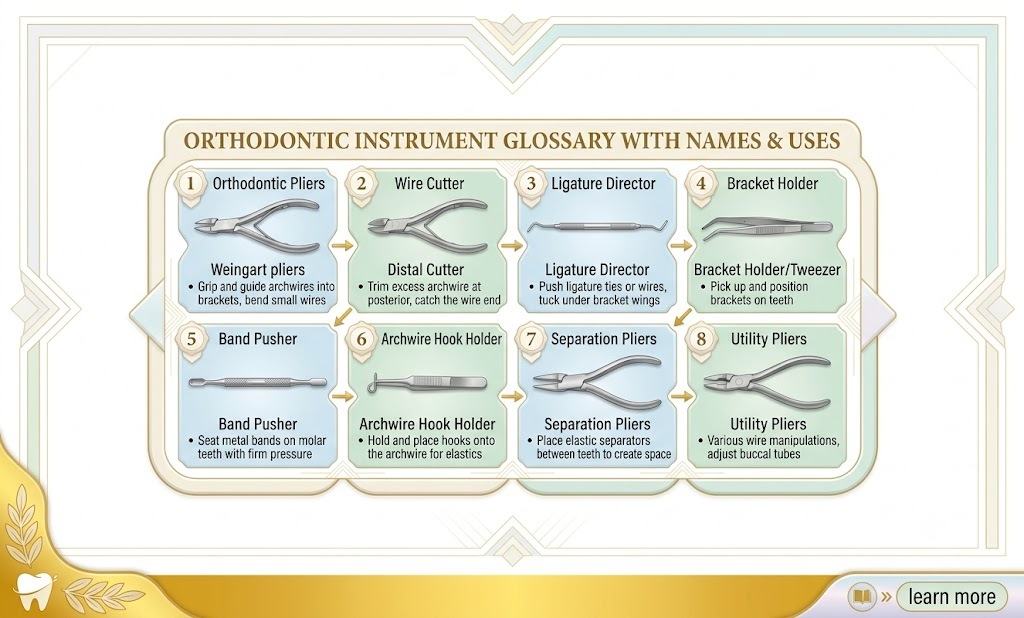
An orthodontic instrument glossary explains the names, functions, and terminology of tools used for braces and other orthodontic procedures. It helps orthodontists, dentists, dental assistants, students, and buyers understand instruments such as Weingart pliers, Bird Beak pliers, distal end cutters, bracket holders, band pushers, and ligature cutters.
Fixed-brace treatment requires precision, and therefore each instrument serves a specific purpose. Understanding orthodontic tool terminology can help dental professionals select the correct instrument, improve workflow, and maintain their instrument sets more effectively (orthodontic instrument terminology).
In this orthodontic instrument glossary, you will learn what common orthodontic tools are called, what they do, how they differ, and how to choose them.
Orthodontic Instrument Glossary: Quick Reference
The following orthodontic instrument glossary provides a quick overview of commonly used orthodontic tools and their primary applications.
| Orthodontic Instrument | Main Purpose | Common Use |
|---|---|---|
| Weingart Pliers | Grip and guide archwires | Archwire placement |
| Bird Beak Pliers | Bend and form wires | Wire adjustment |
| Three-Prong Pliers | Create controlled wire bends | Archwire forming |
| Distal End Cutter | Trim archwire ends | Fixed-brace adjustments |
| Ligature Cutter | Cut suitable ligature materials | Ligature management |
| Archwire Cutter | Cut appropriate orthodontic wire | Wire preparation |
| Bracket Holder | Hold brackets | Bracket placement |
| Bracket Positioning Pliers | Position brackets | Bonding procedures |
| Bracket Removing Pliers | Remove brackets | Debonding |
| Band Pusher | Seat orthodontic bands | Band placement |
| Band Setter | Position bands | Band placement |
| Band Removing Pliers | Remove bands | Band removal |
| Ligature Director | Position and tuck ligatures | Ligature management |
| Mathieu Needle Holder | Hold and manipulate ligatures | Ligature handling |
| Utility Pliers | Grip and manipulate components | General adjustments |
Therefore, this orthodontic instrument glossary can serve as a quick reference when you need to identify a tool before purchasing or using it.
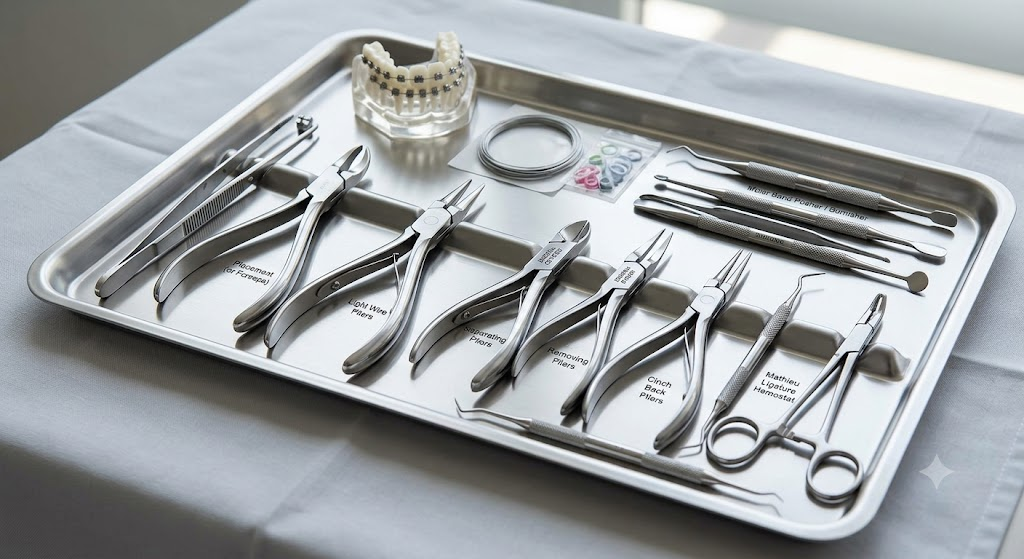
What Are Orthodontic Instruments?
Orthodontic instruments are specialised hand tools that dental professionals use to manipulate brackets, archwires, bands, ligatures, elastomeric modules, and other orthodontic components (orthodontic tools).
For example, clinicians use different tools to:
- Bend orthodontic wires
- Cut archwires
- Guide wires into brackets
- Position brackets
- Remove brackets
- Seat orthodontic bands
- Manage ligatures
- Adjust orthodontic appliances
Because these tasks require different types of control, manufacturers design orthodontic instruments with specific working ends, handles, joints, and cutting edges.
As a result, understanding the terminology in an orthodontic instrument glossary helps professionals match the instrument to the clinical task.
Why Is Orthodontic Instrument Terminology Important?
Orthodontic instruments may look similar at first glance. However, small differences in beak shape, cutting edges, tip design, and handle configuration can significantly change how an instrument performs (orthodontic instruments).
For instance, a Bird Beak plier can help form orthodontic wire, whereas a Weingart plier primarily helps grip and guide archwires.
Similarly, a distal end cutter and a ligature cutter both cut materials, but they serve different purposes.
Therefore, orthodontic instrument terminology matters for several reasons:
- It makes instrument selection easier.
- It helps dental teams communicate clearly.
- It simplifies purchasing and inventory management.
- It supports staff training.
- It helps buyers compare manufacturers.
- It reduces confusion between similar-looking tools.
- It improves organisation of orthodontic instrument sets.
Furthermore, a clear understanding of instrument names can help distributors and procurement teams create more accurate product catalogues.
Orthodontic Instrument Glossary: Main Categories
You can organise orthodontic tools into several functional categories.
1. Orthodontic Pliers
These instruments help clinicians grip, bend, shape, and manipulate orthodontic wires and components.
2. Orthodontic Cutters
These tools cut appropriate archwires, ligatures, or other specified materials.
3. Bracket Instruments
These instruments help clinicians position, hold, adjust, or remove orthodontic brackets.
4. Band Instruments
These tools help clinicians seat, position, or remove orthodontic bands.
5. Ligature Instruments
These instruments help clinicians position, manipulate, tuck, or cut ligatures.
6. Archwire Forming Instruments
These tools help clinicians create specific bends and contours in orthodontic wires.
Consequently, this classification provides a simple foundation for understanding the terminology covered throughout this orthodontic instrument glossary.
Orthodontic Pliers Terminology Explained
Orthodontic pliers form one of the most important categories in any orthodontic instrument glossary. These precision tools allow clinicians to manipulate wires and orthodontic components during different stages of treatment.
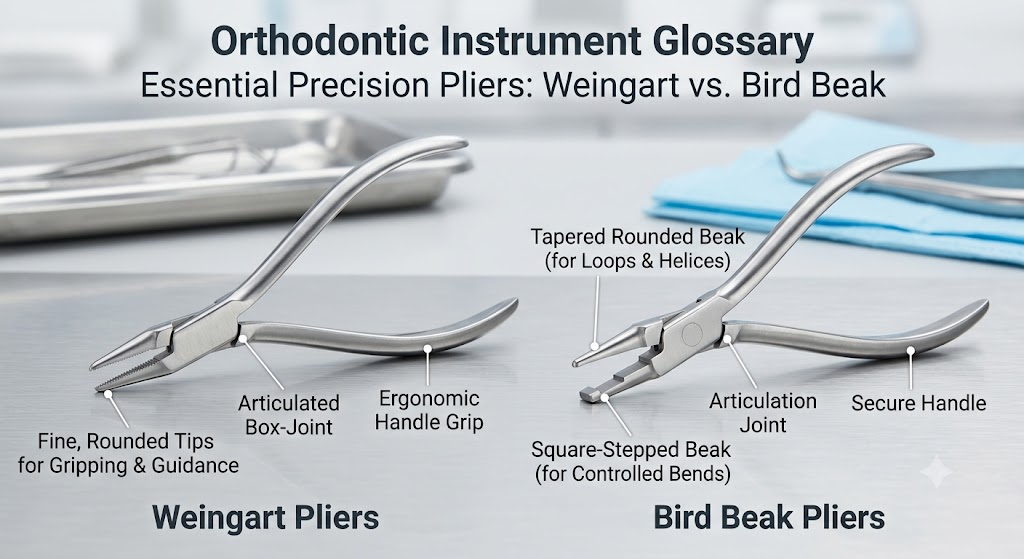
Weingart Pliers
Weingart pliers primarily help clinicians grip, guide, place, and remove orthodontic archwires.
Common uses include:
- Guiding archwires into brackets
- Removing archwires
- Holding wires during adjustments
- Accessing posterior areas
- Manipulating orthodontic components
Their long, narrow working ends can provide useful access around brackets and posterior appliances.
Therefore, Weingart pliers remain an important component of many orthodontic instrument sets.
Bird Beak Pliers
Bird Beak pliers help clinicians bend and form orthodontic wires.
Depending on the design, clinicians may use them for:
- Creating bends
- Forming loops
- Adjusting wire contours
- Creating retention bends
- Making appliance-related wire modifications
The tapered working ends provide controlled wire manipulation.
Three-Prong Pliers
Three-Prong pliers use a specialised three-point working configuration to create controlled bends in orthodontic wire.
They can support:
- Wire forming
- Wire contouring
- Loop formation
- Controlled adjustments
However, the final result depends on the wire diameter, alloy, instrument design, and clinician technique.
Adams Pliers
Adams pliers help clinicians form and adjust orthodontic wires. They can prove particularly useful when the clinician needs controlled bends for orthodontic appliances.
Because different Adams plier designs exist, buyers should check the manufacturer’s specifications before selecting a particular model.
Bird Beak Pliers vs Weingart Pliers
Although both instruments belong in an orthodontic instrument glossary, they perform different jobs.
| Feature | Bird Beak Pliers | Weingart Pliers |
|---|---|---|
| Main function | Wire bending | Wire gripping and guiding |
| Working end | Tapered beaks | Narrow gripping tips |
| Common use | Forming bends and loops | Placing and removing archwires |
| Best suited for | Wire adjustment | Wire handling |
In simple terms, Bird Beak pliers help shape the wire, while Weingart pliers help handle the wire.
Orthodontic Cutter Terminology
Orthodontic cutters require equally careful selection. Although several cutters may look similar, their cutting geometry and intended applications can differ.
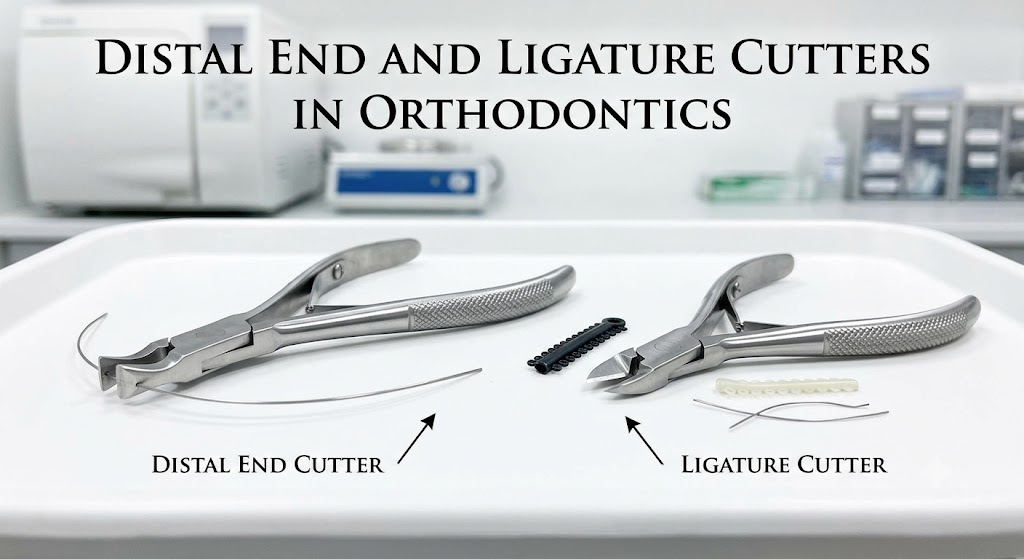
Distal End Cutter
A distal end cutter trims the portion of an orthodontic archwire that extends beyond the posterior end of the appliance.
Clinicians may use it to:
- Trim excess archwire
- Shorten distal wire ends
- Remove protruding wire ends
- Finish wire adjustments
Because clinicians often use distal end cutters in posterior areas, access and tip design matter.
Ligature Cutter
A ligature cutter helps clinicians cut suitable orthodontic ligature materials.
Clinicians may use it during:
- Ligature replacement
- Ligature removal
- Bracket adjustments
- Wire-tie management
The cutting edges should meet accurately. In addition, clinicians should use the cutter only within the material range specified by the manufacturer.
Archwire Cutter
An archwire cutter cuts appropriate orthodontic wire during preparation or adjustment.
For example, clinicians may use an archwire cutter when they need to:
- Prepare a wire
- Adjust wire length
- Modify an appliance
- Perform chairside wire changes
However, an archwire cutter does not automatically replace a distal end cutter. Instead, clinicians should select the tool according to the specific cutting task.
Distal End Cutter vs Ligature Cutter
| Feature | Distal End Cutter | Ligature Cutter |
|---|---|---|
| Primary purpose | Trim appropriate archwire ends | Cut suitable ligature materials |
| Typical application | Archwire adjustment | Ligature management |
| Common location | Posterior appliance areas | Around brackets |
| Main design priority | Wire cutting and access | Fine cutting control |
Therefore, using the correct cutter can help protect the instrument and support predictable clinical handling.
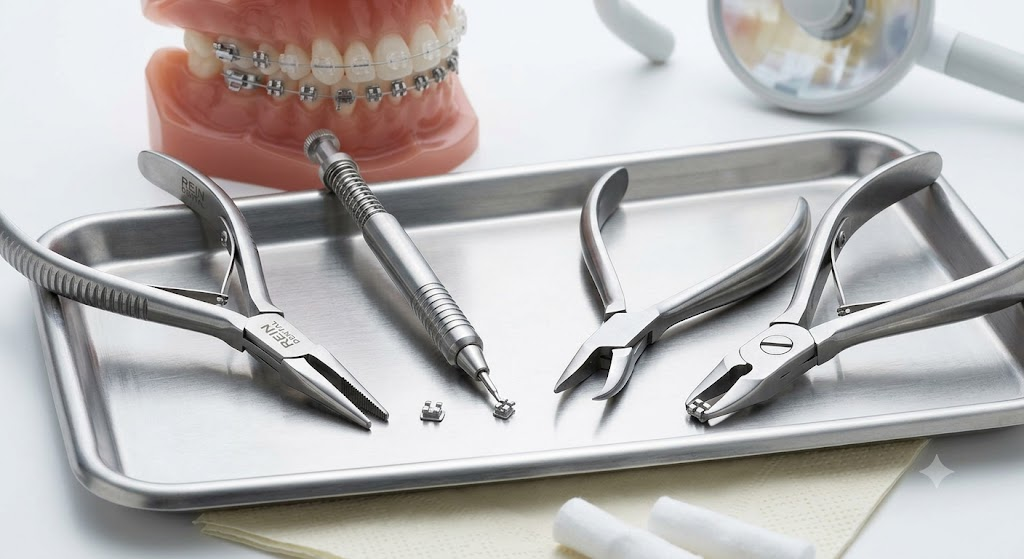
Bracket Instruments in an Orthodontic Instrument Glossary
Brackets provide an essential connection between the tooth and archwire. Consequently, orthodontic practices need dedicated tools for bracket placement, handling, and removal.
Bracket Positioning Pliers
Bracket positioning pliers help clinicians hold and position brackets during bonding.
They can support:
- Controlled bracket handling
- Accurate positioning
- Better access
- Easier manipulation of small brackets
Bracket Holder
A bracket holder helps clinicians hold a bracket during placement.
Since brackets have small dimensions, a suitable holder can make handling easier and more controlled.
Bracket Removing Pliers
Bracket removing pliers help clinicians remove bonded brackets during debonding.
The clinician should select the instrument according to the bracket type, bonding system, and appropriate clinical technique.
Therefore, bracket removal pliers represent another important term in any orthodontic instrument glossary.
Orthodontic Band Instruments
Orthodontic bands can support attachments and appliances around selected teeth. As a result, clinicians may use specialised tools for band seating and removal.
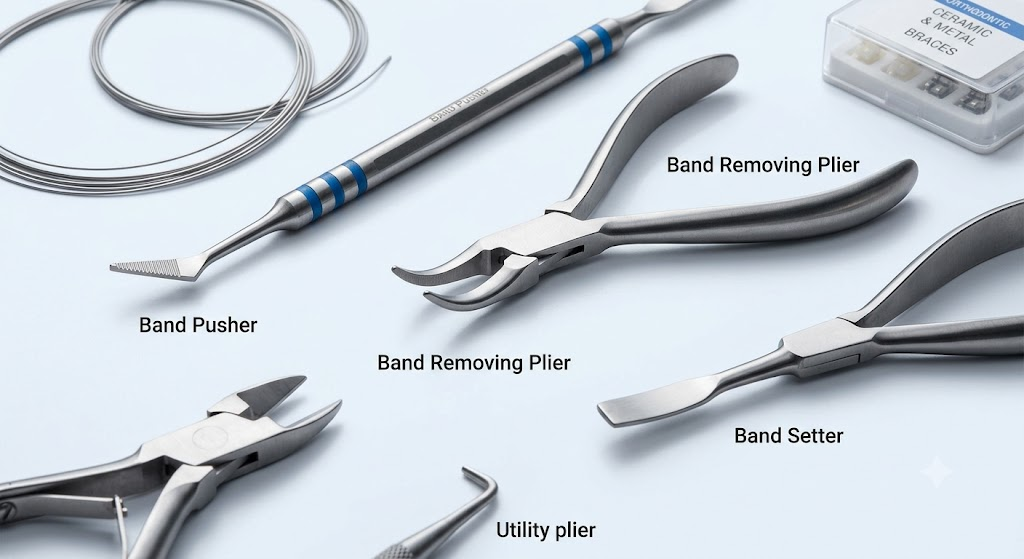
Band Pusher
A band pusher helps seat an orthodontic band during placement.
It can support:
- Band seating
- Controlled pressure
- Band adaptation
- Placement procedures
Band Setter
A band setter helps clinicians position and seat orthodontic bands.
The FDA Product Classification Database lists orthodontic band setters, band pushers, and band drivers under dental hand instruments within its applicable classification framework.
Band Removing Pliers
Band removing pliers help clinicians remove orthodontic bands during appropriate procedures.
Because band instruments have specific working-end designs, buyers should always check the manufacturer’s intended application.
Ligature Instruments Explained
Ligatures can secure an archwire within a bracket. Therefore, clinicians often use several specialised instruments to handle them.
Ligature Director
A ligature director helps clinicians position and tuck ligatures around brackets.
Common applications include:
- Positioning ligatures
- Tucking wire ties
- Managing small orthodontic components
- Improving access around brackets
Mathieu Needle Holder
A Mathieu needle holder features a spring-action mechanism that helps clinicians grip and manipulate small components.
In orthodontic procedures, clinicians may use suitable Mathieu designs for ligature handling.
Ligature Director vs Mathieu Needle Holder
| Instrument | Main Function |
|---|---|
| Ligature Director | Position and tuck ligatures |
| Mathieu Needle Holder | Hold and manipulate ligatures |
| Ligature Cutter | Cut suitable ligature materials |
| Weingart Pliers | Grip and guide archwires |
Consequently, understanding these differences makes orthodontic instrument selection much easier.
Orthodontic Instrument Glossary: Important Braces Terms
Instrument names represent only one part of orthodontic terminology. You should also understand the components that these tools manipulate.
Archwire
An archwire is the wire that engages orthodontic brackets and contributes to controlled tooth movement.
Common orthodontic archwire materials include:
- Stainless steel
- Nickel-titanium alloys
- Other specialised orthodontic alloys
Bracket
A bracket is an orthodontic attachment that clinicians bond to the tooth. The bracket contains a slot designed to receive the archwire.
Bracket Slot
The bracket slot is the opening through which the archwire passes.
Ligature
A ligature secures an archwire within a bracket. Depending on the appliance system, the ligature may use metal wire or an elastomeric material.
Orthodontic Band
An orthodontic band is a metal component that fits around a tooth and can support orthodontic attachments.
Buccal Tube
A buccal tube is a posterior orthodontic attachment that receives or guides an archwire and may accommodate additional components.
Elastomeric Module
An elastomeric module is a small elastic component that helps secure an archwire to a bracket.
Power Chain
A power chain consists of connected elastomeric rings that clinicians may use in selected orthodontic applications.
Hook
An orthodontic hook provides an attachment point for elastics or other components.
Debonding
Debonding refers to removing bonded orthodontic attachments such as brackets.
Distal End
The distal end refers to the section of an archwire that extends beyond the posterior end of the appliance.
Arch Form
Arch form describes the shape or contour of the dental arch and the corresponding shape of an orthodontic archwire.
How to Choose Orthodontic Instruments
Choosing orthodontic tools requires more than comparing prices. Instead, dental professionals and buyers should consider the instrument’s intended purpose, construction, ergonomics, quality, and documentation.
1. Identify the Clinical Task
First, identify exactly what the instrument needs to do.
For example:
- Need to guide an archwire? → Choose suitable Weingart pliers.
- Need to bend wire? → Consider Bird Beak or other forming pliers.
- Need to trim a distal wire end? → Consider a distal end cutter.
- Need to cut ligatures? → Choose an appropriate ligature cutter.
- Need to seat a band? → Consider a band pusher or band setter.
- Need to position a bracket? → Consider a bracket positioning instrument.
- Need to remove a bracket? → Consider suitable bracket removing pliers.
This simple process can prevent unnecessary purchases.
2. Check the Working-End Geometry
Next, examine:
- Beak shape
- Tip dimensions
- Cutting edge design
- Serrations
- Joint construction
- Working-end alignment
The geometry should match the intended clinical task.
3. Consider Instrument Material
Manufacturers commonly use stainless steel for reusable dental and orthodontic instruments because suitable grades can provide strength and corrosion resistance.
However, material selection alone does not determine overall quality. Manufacturing precision, finishing, heat treatment, joint construction, and maintenance also influence instrument performance.
4. Evaluate Ergonomics
Orthodontic professionals repeatedly open, close, grip, and manipulate instruments.
Therefore, consider:
- Handle comfort
- Grip
- Weight
- Balance
- Spring action
- Joint movement
- Ease of cleaning
5. Check Supplier Documentation
Finally, ask the supplier for relevant product and quality documentation.
Depending on the product and target market, documentation may include:
- Product specifications
- Manufacturer information
- Quality-system certificates
- Regulatory information
- Traceability details
- Cleaning instructions
- Sterilisation instructions
ISO 13485 and Orthodontic Instruments
Quality management also matters when buyers evaluate orthodontic instrument manufacturers.
ISO 13485:2016 provides requirements for a quality management system specific to medical devices. The standard focuses on processes that help organisations meet customer and applicable regulatory requirements.
Therefore, buyers can consider ISO 13485 certification as one part of their supplier assessment.
However, ISO 13485 certification does not automatically mean that every individual orthodontic instrument has FDA approval or EU conformity.
Instead, buyers should request:
- The certificate
- The certificate scope
- Product documentation
- Applicable regulatory information
- Manufacturer details
For authoritative information, consult the official ISO 13485:2016 standard.
FDA Classification of Orthodontic Hand Instruments
The US FDA lists various dental hand instruments within its product classification database. For example, the database includes orthodontic ligature tucking instruments, orthodontic band setters, band pushers, and band drivers under dental hand instruments.
However, classification does not mean that every product from every manufacturer automatically has the same regulatory status.
Therefore, US buyers should verify the requirements that apply to the specific device, manufacturer, and intended use.
You can review the official FDA Product Classification Database for additional information.
Orthodontic Instrument Glossary: Quality Checklist
Before purchasing orthodontic instruments, use this checklist.
Construction
- Suitable stainless-steel construction
- Accurate working ends
- Smooth surface finish
- Consistent manufacturing
- Appropriate corrosion resistance
Performance
- Correct instrument geometry
- Properly aligned cutting edges
- Smooth joint action
- Secure grip
- Appropriate spring action
Clinical Usability
- Comfortable handles
- Suitable weight and balance
- Easy to clean
- Appropriate for the intended procedure
Supplier Documentation
- Product specifications
- Manufacturer information
- Relevant quality certificates
- Applicable regulatory documentation
- Cleaning instructions
- Sterilisation instructions
- Product traceability information
Must-Have Orthodontic Instruments for Fixed Braces
A practical fixed-braces instrument set should reflect the procedures that a dental practice performs regularly.
Wire Management
Consider:
- Weingart pliers
- Bird Beak pliers
- Three-Prong pliers
- Archwire cutters
- Distal end cutters
Bracket Management
Consider:
- Bracket positioning instruments
- Bracket holders
- Bracket removing pliers
Ligature Management
Consider:
- Ligature cutters
- Ligature directors
- Mathieu needle holders
Band Management
Consider:
- Band pushers
- Band setters
- Band removing pliers
General Support
Depending on the procedure, a practice may also require:
- Orthodontic tweezers
- Utility pliers
- Dental mirrors
- Other examination instruments
Consequently, practices should build their instrument sets around their actual clinical workflows rather than purchasing every available instrument.
How to Organise an Orthodontic Instrument Tray
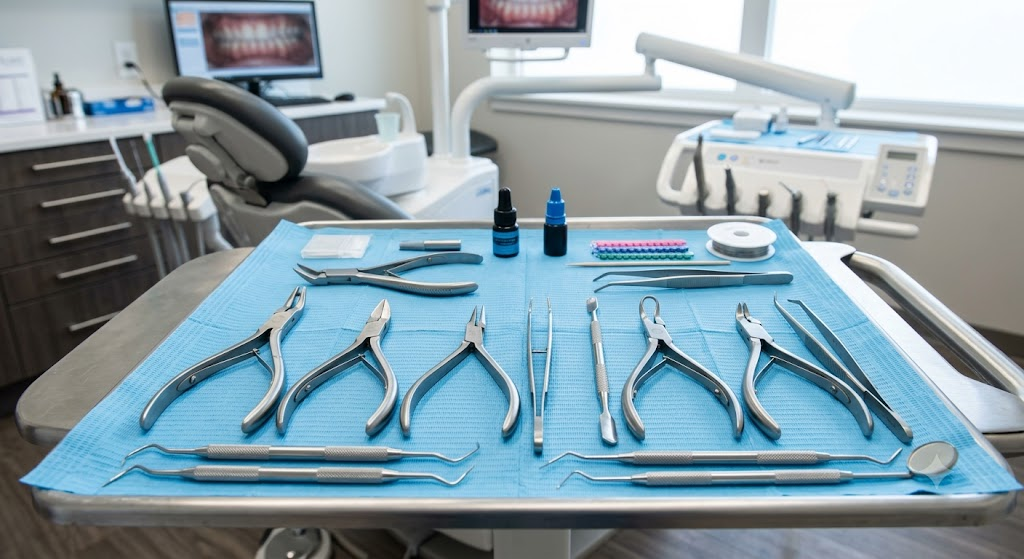
A logical tray arrangement can make instrument selection faster.
Section 1: Examination and Positioning
Place:
- Mouth mirror
- Orthodontic tweezers
- Bracket positioning instruments
Section 2: Wire Management
Place:
- Weingart pliers
- Bird Beak pliers
- Three-Prong pliers
- Archwire cutter
- Distal end cutter
Section 3: Ligature Management
Place:
- Ligature cutter
- Ligature director
- Mathieu needle holder
Section 4: Band Management
Place:
- Band pusher
- Band setter
- Band removing pliers
As a result, the team can follow a more logical workflow from examination through adjustment and finishing.
How to Maintain Orthodontic Instruments
Proper maintenance helps practices preserve instrument performance and identify problems early.
Step 1: Inspect the Instrument
First, check for:
- Damaged tips
- Misaligned cutting edges
- Loose joints
- Corrosion
- Surface damage
Step 2: Clean the Instrument
Next, follow the manufacturer’s cleaning instructions.
Do not assume that every instrument can tolerate every cleaning chemical, ultrasonic cycle, or automated process.
Step 3: Inspect After Cleaning
Then, examine:
- Cutting edges
- Serrations
- Joints
- Working ends
Step 4: Sterilise According to Instructions
Use the validated sterilisation method recommended for the specific instrument.
Step 5: Store Correctly
Finally, keep instruments:
- Clean
- Dry
- Protected
- Organised
- Easily identifiable
If a cutter no longer produces a clean cut, inspect it instead of forcing it through material outside its intended range.
Common Orthodontic Instrument Selection Mistakes
Mistake 1: Using One Plier for Every Task
Different pliers have different working-end geometries.
Better approach: Match the instrument to the specific procedure.
Mistake 2: Using the Wrong Cutter
Cutters have specific material and size limitations.
Better approach: Check the manufacturer’s recommended application before cutting.
Mistake 3: Ignoring Ergonomics
Even a technically accurate instrument can feel uncomfortable during repeated use.
Better approach: Evaluate handle design, balance, grip, and joint movement.
Mistake 4: Buying Only on Price
A low purchase price does not necessarily equal lower long-term cost.
Better approach: Compare quality, durability, performance, documentation, and supplier support.
Mistake 5: Confusing Certification Claims
Some suppliers mention CE, FDA, or ISO 13485 without clearly explaining the scope of their claims.
Better approach: Ask for the actual certificate or regulatory documentation and verify its scope.
Orthodontic Instrument Glossary A–Z
A — Archwire
An archwire engages orthodontic brackets and helps deliver controlled forces during treatment.
B — Band Pusher
A band pusher helps clinicians seat orthodontic bands during placement.
B — Bird Beak Pliers
Bird Beak pliers feature tapered working ends that help clinicians bend and form orthodontic wires.
B — Bracket
A bracket attaches to a tooth and receives the orthodontic archwire.
B — Bracket Holder
A bracket holder helps clinicians hold and manipulate brackets during placement.
B — Buccal Tube
A buccal tube provides a posterior attachment that receives or guides an archwire and related components.
D — Debonding
Debonding describes the removal of bonded orthodontic attachments.
D — Distal End
The distal end refers to the portion of an archwire extending beyond the posterior end of the appliance.
D — Distal End Cutter
A distal end cutter trims appropriate archwire ends after placement.
E — Elastomeric Module
An elastomeric module is a small elastic component that secures an archwire to a bracket.
L — Ligature
A ligature secures an archwire within an orthodontic bracket.
L — Ligature Cutter
A ligature cutter cuts suitable orthodontic ligature materials.
L — Ligature Director
A ligature director helps position and tuck ligatures.
M — Mathieu Needle Holder
A Mathieu needle holder uses a spring-action mechanism to help clinicians hold and manipulate small components.
T — Three-Prong Pliers
Three-Prong pliers help clinicians create controlled bends in orthodontic wire.
W — Weingart Pliers
Weingart pliers help clinicians grip, guide, place, and remove orthodontic archwires.
Orthodontic Instruments vs General Dental Instruments
Although many dental instruments look similar, their intended purposes differ.
| Category | Main Purpose | Examples |
|---|---|---|
| General dental instruments | Examination and routine dental care | Mouth mirrors, explorers, probes |
| Orthodontic instruments | Wire, bracket, band, and appliance management | Weingart pliers, distal end cutters |
| Periodontal instruments | Periodontal assessment and treatment | Scalers, curettes |
| Endodontic instruments | Root canal procedures | Files, spreaders, pluggers |
| Oral surgery instruments | Surgical procedures | Elevators, forceps, retractors |
Therefore, professionals should choose instruments according to their intended clinical application.
How to Build an Orthodontic Instrument Set
A simple purchasing process can help dental practices build an efficient instrument set.
Step 1: List Your Procedures
Identify whether your practice performs:
- Fixed braces
- Bracket bonding
- Band placement
- Archwire adjustments
- Ligature changes
- Debonding
- Finishing procedures
Step 2: Match Procedures With Instruments
Next, identify the instruments required for each procedure.
Step 3: Build a Core Set
Start with frequently used instruments.
Step 4: Add Specialist Instruments
Then, add specialised tools according to your clinical techniques.
Step 5: Monitor Instrument Condition
Finally, track:
- Cutting performance
- Joint movement
- Tip alignment
- Surface condition
- Maintenance requirements
As a result, practices can manage inventory more efficiently and plan replacements before instruments become unusable.
How to Evaluate an Orthodontic Instrument Supplier
Supplier selection matters just as much as instrument selection, especially for clinics, distributors, importers, and procurement teams.
Does the Manufacturer Provide Specifications?
Clear product specifications help buyers compare instruments accurately.
Does the Supplier Provide Quality Documentation?
Look for relevant quality-system and regulatory documentation for the target market.
Can the Supplier Support Bulk Orders?
Distributors and dental groups often need reliable product availability.
Does the Supplier Offer OEM or Private-Label Services?
This option can benefit established dental brands and importers.
Can the Supplier Provide a Catalogue?
A detailed catalogue helps buyers build complete orthodontic and dental product ranges.
Does the Supplier Understand Orthodontic Instruments?
A specialist supplier should explain differences between plier designs, cutters, wire-forming tools, bracket instruments, and band instruments.
Explore Rhein Dental Orthodontic Instruments
Rhein Dental provides a broad range of orthodontic products for dental professionals, distributors, and other professional buyers. The range includes orthodontic pliers, bracket-related instruments, band instruments, wire cutters, and other orthodontic tools.
You can explore the Rhein Dental Orthodontic Products category to compare available products.
You can also browse the wider Rhein Dental Dental & Surgical Instrument Shop when you need instruments for other dental procedures.
For readers interested specifically in plier terminology, link naturally to Rhein Dental’s Types of Orthodontic Pliers Guide.
Orthodontic Instrument Glossary: Quick Decision Guide
Need to guide an archwire?
→ Consider Weingart pliers.
Need to bend orthodontic wire?
→ Consider Bird Beak, Adams, or other appropriate forming pliers.
Need to create a controlled wire bend?
→ Consider three-prong or specialised wire-forming pliers.
Need to trim a distal wire end?
→ Consider a distal end cutter.
Need to cut suitable ligature material?
→ Consider a ligature cutter.
Need to position a bracket?
→ Consider a bracket positioning instrument or holder.
Need to seat a band?
→ Consider a band pusher or band setter.
Need to remove a bracket?
→ Consider suitable bracket removing pliers.
Therefore, this quick guide can help buyers identify the correct instrument category before selecting a specific model.
Frequently Asked Questions About Orthodontic Instrument Terminology
What are the most common orthodontic instruments?
Common orthodontic instruments include Weingart pliers, Bird Beak pliers, distal end cutters, ligature cutters, bracket positioning instruments, band pushers, three-prong pliers, archwire cutters, ligature directors, and Mathieu needle holders.
What are Weingart pliers used for?
Weingart pliers help clinicians grip, guide, place, and remove orthodontic archwires during fixed-brace procedures.
What are Bird Beak pliers used for?
Bird Beak pliers help clinicians bend and shape orthodontic wire. Their tapered working ends allow controlled bends and loops.
What does a distal end cutter do?
A distal end cutter trims an appropriate orthodontic archwire end after the clinician positions the wire in a fixed orthodontic appliance.
What instrument cuts orthodontic ligatures?
A ligature cutter cuts suitable orthodontic ligature materials. Clinicians should follow the manufacturer’s recommendations for the specific instrument.
What instruments help with orthodontic bands?
Band pushers, band setters, and band removing pliers help clinicians place and remove orthodontic bands.
What instruments do dentists use for fixed braces?
Fixed-brace instrument sets commonly include orthodontic pliers, distal end cutters, archwire cutters, ligature cutters, bracket positioning tools, band pushers, ligature directors, and other procedure-specific instruments.
What is an orthodontic instrument glossary?
An orthodontic instrument glossary explains the names, terminology, functions, and applications of tools used during orthodontic procedures.
What is the difference between orthodontic pliers and dental forceps?
Orthodontic pliers primarily manipulate wires and orthodontic components, whereas dental forceps generally support tooth extraction. Their designs and intended applications differ.
How do I choose orthodontic instruments?
Choose orthodontic instruments according to their clinical purpose, working-end geometry, material, ergonomics, durability, maintenance requirements, and applicable quality or regulatory documentation.
How should orthodontic instruments be maintained?
Follow the manufacturer’s cleaning, inspection, sterilisation, lubrication, and storage instructions. In addition, inspect working ends and joints regularly for wear or damage.
Does ISO 13485 mean an orthodontic instrument has FDA approval?
No. ISO 13485 addresses a medical-device quality management system, whereas FDA regulatory requirements apply separately to products marketed in the United States.
Are all orthodontic instruments CE marked?
Not necessarily. CE requirements depend on the product, intended purpose, manufacturer, target market, and applicable European legislation.
Final Orthodontic Instrument Glossary Checklist
Before buying an orthodontic instrument, ask:
- What clinical task will it perform?
- Does the working end match that task?
- What material can it safely handle?
- Does the instrument use suitable stainless steel?
- Are the cutting edges aligned?
- Does the joint move smoothly?
- Does the handle provide comfortable control?
- Can the instrument follow the manufacturer’s cleaning and sterilisation instructions?
- Does the manufacturer provide specifications?
- Does the supplier provide relevant quality documentation?
- Can the supplier maintain consistent product availability?
By answering these questions, dental practices and distributors can make better-informed purchasing decisions.
Recommended External Sources
For additional technical and regulatory information, readers can consult authoritative resources from:
- ISO — ISO 13485:2016 Medical Devices Quality Management Systems
- U.S. FDA — Product Classification Database