
Microsurgical vs Conventional Endodontics – The Rise of Microsurgical Endodontics
Endodontics focuses on saving teeth through root canal treatment and related procedures. Over the years, the field has evolved dramatically. In the past, endodontic surgery depended mainly on a dentist’s skill, basic magnification, and manual precision. However, with the advent of microsurgical endodontics, the approach to root canal surgery has transformed. Today, specialists perform these procedures with far greater precision, predictability, and patient comfort.
This article explores how microsurgical endodontics differs from conventional endodontics, and why this modern approach continues to redefine root canal treatment.
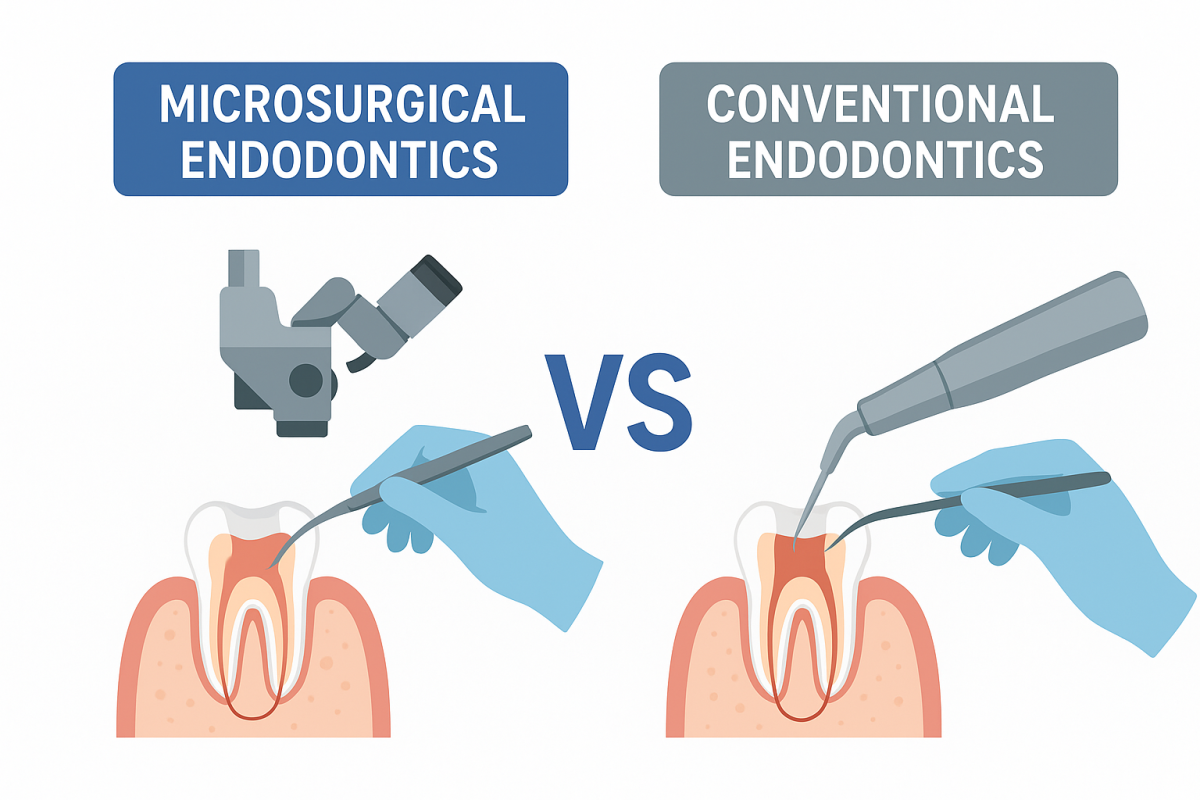
What Is Conventional Endodontics?
Conventional endodontics includes standard root canal therapy and traditional endodontic surgery such as apicoectomy. These procedures aim to remove infected pulp, clean and shape the canals, and then seal them to prevent future infection.
Although these techniques have saved millions of teeth, they also present some limitations:
- Dentists often struggle with limited visibility of complex root canal anatomy.
- The procedures usually involve larger incisions and greater tissue trauma.
- Clinicians may experience reduced accuracy when identifying micro-fractures or hidden canals.
As a result, treatment success may vary based on the clinician’s experience and the case complexity.
What Is Microsurgical Endodontics?
Microsurgical endodontics represents an advanced form of endodontic surgery. Dentists perform it under high magnification and illumination using a dental operating microscope or an endoscope. This technique combines clear visualization with refined microsurgical instruments and modern biomaterials to achieve outstanding results.
With this approach, endodontists can:
- Clearly view the root-end anatomy at up to 25x magnification.
- Make smaller, more precise incisions, preserving healthy tissue.
- Use ultrasonic and micro-instruments for cleaner, more conservative root-end preparation.
- Seal the root-end with biocompatible materials such as MTA or bioceramics, ensuring better healing.
In short, microsurgical endodontics enhances accuracy, reduces discomfort, and improves long-term outcomes.
Key Differences Between Microsurgical and Conventional Endodontics
| Aspect | Conventional Endodontics | Microsurgical Endodontics |
|---|---|---|
| Visualization | Limited, often without magnification | Enhanced view under microscope |
| Precision | Depends on manual feel | Controlled precision with micro-instruments |
| Incision Size | Larger, more invasive | Smaller and minimally invasive |
| Tissue Healing | Slower due to more trauma | Faster with minimal tissue disruption |
| Success Rate | Around 60–70% for complex cases | Up to 90–95% for similar cases |
| Patient Recovery | Longer and more uncomfortable | Shorter and more comfortable |
Advantages of Microsurgical Endodontics
- Improved Diagnostic Accuracy
The microscope helps dentists detect root fractures, isthmuses, and accessory canals that remain invisible to the naked eye. - Greater Surgical Precision
Micro-instruments allow clinicians to remove only the infected tissue while preserving the natural tooth structure. - Reduced Postoperative Discomfort
Because the procedure requires smaller incisions, patients experience less swelling and faster healing. - Enhanced Aesthetic Results
Gentle tissue handling maintains the natural shape of the gums and improves overall appearance. - Higher Long-Term Success Rates
With precise sealing and minimal trauma, treated teeth have a significantly better prognosis.
When Should You Consider Microsurgical Endodontics?
Dentists usually recommend microsurgical endodontics when:
- A previous root canal treatment fails and retreatment isn’t possible.
- A patient has persistent periapical lesions or cysts.
- The root canal system becomes blocked or calcified.
- A fractured instrument remains inside the canal.
In each of these situations, microsurgical techniques give clinicians the control and visibility they need to save the tooth.
The Future of Endodontic Care
As technology advances, microsurgical endodontics continues to set new standards for root canal surgery. Patients benefit from more predictable results, quicker recovery, and a more comfortable experience overall.
For clinicians, these techniques go beyond tools and technology—they represent a shift toward precision, conservation, and excellence in patient care.
Final Thoughts
While conventional endodontics remains effective for many cases, microsurgical endodontics delivers clear advantages in complex or previously failed treatments. This innovative approach combines science, technology, and skill to save teeth that once seemed unsalvageable.
If you face a complicated root canal or a failed previous treatment, ask your endodontist whether microsurgical endodontics suits your case. It might be the key to saving your natural tooth and restoring your oral health.