
Orthodontic treatment relies on precision. Every adjustment, bend, cut, and placement depends on the accuracy and reliability of the instruments being used. Whether it’s a distal end cutter, ligature cutter, Weingart pliers, or bracket positioning tweezers, even the smallest manufacturing inconsistency can affect treatment outcomes.
This is why have become the global benchmark for producing safe, durable, and reliable instruments.
Today, dentists, orthodontists, hospitals, distributors, and procurement teams increasingly prefer ISO orthodontic instruments because they provide documented assurance that every instrument meets internationally recognized quality, safety, and manufacturing requirements.
In this guide, we’ll explain everything you need to know about ISO standards, why they matter, and how they ensure superior orthodontic instrument quality.
What Are ISO Standards?
ISO stands for the International Organization for Standardization, an independent international body that develops globally accepted standards across industries, including medical devices and dental instruments.
ISO standards establish requirements for:
- Manufacturing processes
- Material quality
- Product consistency
- Traceability
- Sterilization
- Risk management
- Quality management systems
- Product inspection
- Documentation
- Continuous improvement
For orthodontic manufacturers, complying with ISO standards demonstrates a commitment to producing high-quality instruments that consistently meet customer expectations.
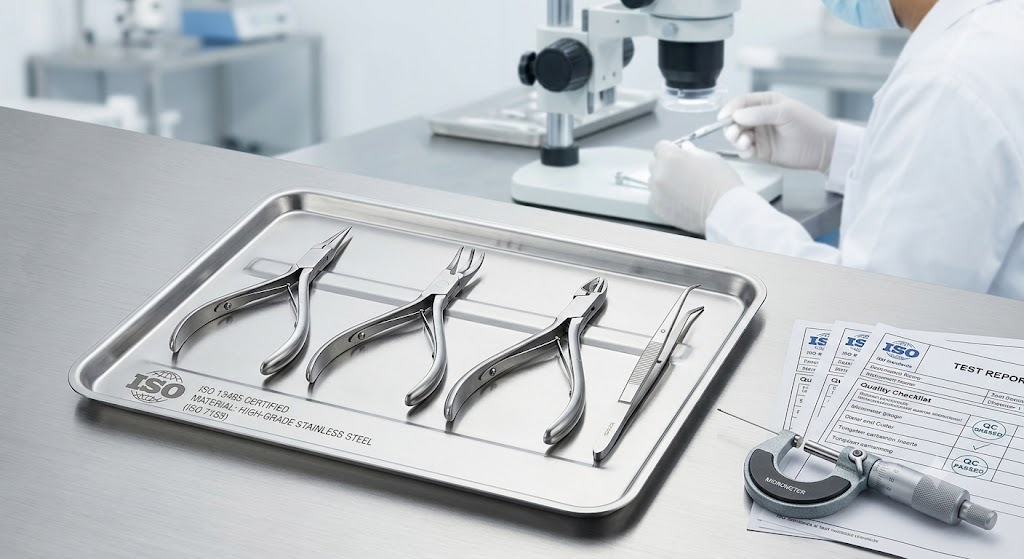
Why ISO Standards Matter in Orthodontic Manufacturing
Orthodontic instruments are used repeatedly during delicate clinical procedures. Poor-quality instruments may:
- Lose alignment
- Develop corrosion
- Become dull
- Fail under pressure
- Damage orthodontic wires
- Cause inaccurate bracket positioning
- Increase chair time
- Affect patient safety
ISO manufacturing standards minimize these risks by ensuring every instrument undergoes strict quality control before reaching clinicians.
Benefits include:
- Improved patient safety
- Greater instrument longevity
- Better clinical precision
- Consistent manufacturing quality
- Reliable sterilization compatibility
- International market acceptance
- Regulatory compliance
The Most Important ISO Standards for Orthodontic Instruments
1. ISO 13485 – Medical Device Quality Management System
ISO 13485 is considered the gold standard for medical device manufacturers.
It specifies how manufacturers should manage quality throughout production.
Requirements include:
- Documented manufacturing procedures
- Supplier qualification
- Risk management
- Product traceability
- Inspection protocols
- Complaint handling
- Corrective actions
- Process validation
- Employee training
Manufacturers of ISO certified dental instruments often implement ISO 13485 to demonstrate a robust quality management system.
Benefits
- Consistent product quality
- Better customer confidence
- Easier regulatory approvals
- Reduced manufacturing errors
2. ISO 7153-1 – Stainless Steel for Surgical Instruments
Orthodontic instruments are primarily manufactured from stainless steel.
ISO 7153 specifies suitable stainless steel grades for surgical instruments, helping ensure:
- Corrosion resistance
- Strength
- Hardness
- Sterilization compatibility
- Long service life
Premium orthodontic instruments commonly use high-grade stainless steel that complies with this standard.
3. ISO 14971 – Risk Management for Medical Devices
Every medical device presents potential risks.
ISO 14971 requires manufacturers to:
- Identify hazards
- Analyze risks
- Reduce risks
- Monitor performance
- Improve products continuously
For orthodontic instruments, this helps reduce:
- Instrument breakage
- Manufacturing defects
- Clinical failures
- Safety issues
4. ISO 17664 – Sterilization Information
Orthodontic instruments must withstand repeated sterilization cycles.
ISO 17664 defines the information manufacturers should provide for:
- Cleaning
- Disinfection
- Sterilization
- Storage
- Maintenance
This ensures reusable instruments remain safe throughout their lifecycle.
5. ISO 10993 – Biocompatibility
Although orthodontic instruments have limited patient contact, biocompatibility remains important.
ISO 10993 evaluates:
- Material safety
- Toxicity
- Irritation potential
- Biological compatibility
This helps ensure patient safety during clinical use.
How ISO Standards Improve Orthodontic Instrument Quality
Precision Manufacturing
Orthodontic pliers require exceptional accuracy.
ISO manufacturing systems ensure:
- Accurate jaw alignment
- Proper tip geometry
- Smooth joint movement
- Consistent cutting edges
- Reliable spring tension
Every instrument is inspected against strict tolerances before shipment.
Superior Material Selection
ISO standards require manufacturers to source high-quality raw materials.
Benefits include:
- Better corrosion resistance
- Longer lifespan
- Improved hardness
- Enhanced polishing
- Superior wear resistance
High-grade stainless steel maintains its performance after repeated sterilization.
Consistent Manufacturing Processes
Every production batch follows standardized procedures.
This ensures:
- Uniform dimensions
- Consistent finish
- Identical functionality
- Reliable mechanical performance
Clinicians receive instruments that perform consistently over time.
Enhanced Durability
Repeated opening, closing, cutting, and sterilization place significant stress on orthodontic instruments.
ISO-compliant production includes:
- Heat treatment
- Hardness testing
- Fatigue testing
- Mechanical strength verification
The result is greater durability and fewer instrument failures.
Better Corrosion Resistance
Corrosion reduces both instrument life and patient safety.
ISO manufacturing controls help ensure:
- Proper alloy selection
- Passivation
- Surface finishing
- Protective polishing
This extends instrument lifespan even after hundreds of sterilization cycles.
Quality Control During Orthodontic Instrument Manufacturing
Leading manufacturers implement multiple inspection stages.
Incoming Material Inspection
Raw materials are checked for:
- Chemical composition
- Surface quality
- Hardness
- Certifications
In-Process Inspection
During manufacturing, technicians verify:
- Dimensions
- Jaw alignment
- Cutting accuracy
- Surface finish
- Mechanical movement
Final Inspection
Before packaging, every instrument is assessed for:
- Cosmetic appearance
- Functional testing
- Cutting performance
- Joint smoothness
- Laser marking
- Packaging quality
Only instruments that meet strict quality criteria proceed to shipment.
Why Orthodontists Prefer ISO Orthodontic Instruments
Experienced orthodontists understand that precision instruments improve treatment efficiency.
Benefits include:
- Better wire bending
- Cleaner cuts
- Improved bracket placement
- Reduced treatment errors
- Shorter appointments
- Enhanced patient comfort
- Greater clinical confidence
Reliable instruments also reduce replacement costs over time.
ISO Standards and CE Certification
Many buyers mistakenly believe ISO certification and CE marking are the same.
They are different but complementary.
ISO Certification focuses on the manufacturer’s quality management system and production processes.
CE Certification demonstrates that a medical device complies with applicable regulatory requirements for sale in certain markets.
Manufacturers that hold both ISO certification and CE certification often demonstrate strong commitments to quality and regulatory compliance.
Choosing an ISO-Certified Orthodontic Instrument Manufacturer
When evaluating suppliers, consider:
Quality Certifications
Look for:
- ISO 13485 certification
- CE certification (where applicable)
- Quality management documentation
Manufacturing Experience
Experienced manufacturers generally offer:
- Better process control
- Skilled technicians
- Advanced machinery
- Consistent quality
Material Quality
Choose manufacturers using:
- Medical-grade stainless steel
- Corrosion-resistant alloys
- Certified raw materials
Inspection Procedures
Ask whether the manufacturer performs:
- Hardness testing
- Alignment inspection
- Cutting performance tests
- Functional testing
- Final quality inspection
Traceability
Reliable manufacturers maintain production records that enable product traceability and support quality assurance.
Common Orthodontic Instruments Manufactured Under ISO Standards
Examples include:
- Distal End Cutters
- Ligature Cutters
- Weingart Pliers
- Bird Beak Pliers
- Three-Prong Pliers
- Bracket Holding Tweezers
- Mathieu Needle Holders
- Band Removing Pliers
- Band Pushers
- Utility Pliers
- Arch Forming Pliers
- Cinch Back Pliers
- Torque Pliers
- Ligature Directors
- Bracket Positioning Gauges
Each instrument benefits from standardized manufacturing controls that promote precision and consistency.
Future Trends in ISO Orthodontic Manufacturing
The orthodontic industry continues to evolve with technologies that complement ISO quality systems.
Emerging trends include:
- Digital quality inspection
- AI-assisted defect detection
- CNC precision machining
- Robotic polishing
- Laser welding
- Smart traceability systems
- Automated dimensional measurement
- Sustainable manufacturing practices
These innovations support even higher levels of consistency and quality.
Final Thoughts
Precision is essential in orthodontics, and manufacturing quality plays a significant role in achieving reliable clinical outcomes. ISO standards in orthodontic manufacturing provide a structured framework for quality management, material selection, process control, risk management, and inspection.
By choosing ISO orthodontic instruments from reputable manufacturers, dental professionals can benefit from consistent performance, enhanced durability, and confidence that their instruments are produced under internationally recognized quality systems. As orthodontic manufacturing continues to advance through automation, digital inspection, and improved materials, ISO standards will remain a cornerstone of quality and trust across the global dental industry.
Frequently Asked Questions:
ISO orthodontic instruments are manufactured under internationally recognized quality management systems and standards that emphasize consistency, safety, and performance.
ISO 13485 establishes requirements for a medical device quality management system, helping manufacturers produce consistent, reliable, and compliant products.
ISO certification indicates that a manufacturer follows recognized quality management practices. While it is a strong indicator of process quality, buyers should also evaluate factors such as materials, design, testing, and regulatory compliance.
High-quality orthodontic instruments are typically made from medical-grade stainless steel selected for corrosion resistance, strength, and durability.
ISO standards require documented quality controls, risk management, inspection, and traceability, which help reduce manufacturing defects and improve product reliability.
When manufactured with quality materials and proper processes, ISO-compliant instruments are generally designed for durability and repeated sterilization, though lifespan also depends on usage and maintenance.