
Orthodontic procedures require exceptional precision, and the success of every treatment often depends on using the right instrument for the right task. Among the most commonly confused orthodontic tools are ligature cutting pliers and distal end cutting pliers. While both are designed to cut orthodontic wires, they serve entirely different purposes and cannot be used interchangeably without compromising efficiency, patient comfort, and clinical outcomes.
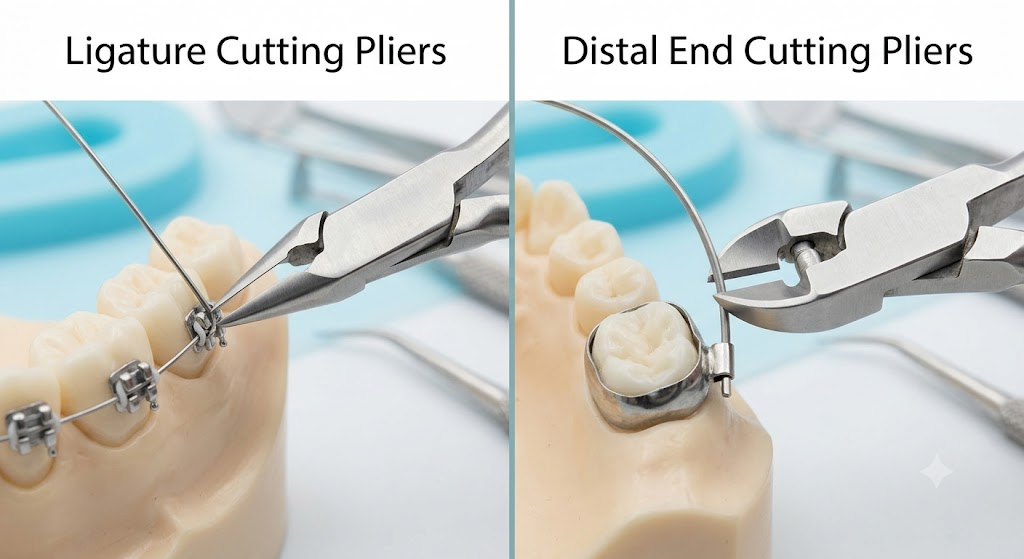
Whether you’re an orthodontist, dentist, dental student, orthodontic assistant, or purchasing manager, understanding the differences between ligature cutting pliers vs distal end cutting pliers helps improve workflow, extend instrument lifespan, and ensure safer procedures.
This comprehensive guide explains their design, applications, advantages, differences, maintenance requirements, and how to choose the right orthodontic cutting pliers for your practice.
What Are Ligature Cutting Pliers?
Ligature cutting pliers are specialized orthodontic instruments designed specifically for cutting soft ligature wires used to secure archwires into orthodontic brackets.
These pliers are engineered with:
- Sharp precision cutting edges
- Compact angled jaws
- Fine tips for improved visibility
- Lightweight ergonomic handles
Unlike heavy-duty cutters, ligature cutters are optimized for cutting thin stainless steel ligature wires without deforming adjacent brackets or archwires.
Primary Uses of Ligature Cutting Pliers
Ligature cutting pliers are commonly used for:
- Cutting stainless steel ligature wires
- Removing twisted ligatures
- Trimming excess ligature wire
- Finishing wire ties
- Adjusting orthodontic appliances
- Routine orthodontic appointments
They are not intended for cutting thick archwires.
What Are Distal End Cutting Pliers?
Distal end cutting pliers are heavy-duty orthodontic cutting instruments specifically designed to cut the distal ends of archwires after placement.
One of their defining features is the wire-holding mechanism, which safely captures the cut wire segment and prevents it from falling into the patient’s mouth.
Their design typically includes:
- Strong tungsten carbide cutting inserts
- Angled cutting head
- Safety hold mechanism
- High mechanical leverage
- Reinforced stainless steel construction
These pliers can cut heavy orthodontic wires while maintaining patient safety.
Primary Uses of Distal End Cutting Pliers
Distal end cutters are used for:
- Cutting excess archwire
- Trimming distal wire extensions
- Cutting rectangular wires
- Cutting nickel titanium wires
- Cutting stainless steel archwires
- Preventing wire aspiration
- Finishing orthodontic wire placement
Ligature Cutting Pliers vs Distal End Cutting Pliers
Understanding the differences helps clinicians choose the appropriate instrument.
| Feature | Ligature Cutting Pliers | Distal End Cutting Pliers |
|---|---|---|
| Primary Purpose | Cut ligature wires | Cut archwires |
| Wire Thickness | Thin wires only | Thin to heavy wires |
| Holding Mechanism | No | Yes |
| Cutting Force | Moderate | High |
| Jaw Design | Fine precision tips | Heavy-duty cutting jaws |
| Safety Feature | None | Holds cut wire segment |
| Best For | Ligature removal | Distal archwire trimming |
| Orthodontic Stage | Routine adjustments | Wire insertion and finishing |
Design Differences
Ligature Cutting Pliers
Designed for delicate orthodontic work.
Characteristics include:
- Fine tapered jaws
- Sharp cutting edges
- Lightweight construction
- Better intraoral access
- Excellent visibility
These features allow accurate cutting in crowded areas.
Distal End Cutting Pliers
Designed for maximum cutting power.
Features include:
- Short powerful jaws
- Angled cutting head
- Heavy-duty hinge
- Tungsten carbide inserts
- Wire-retention system
Their construction minimizes clinician effort while producing clean cuts.
Wire Types Each Instrument Can Cut
Ligature Cutting Pliers Can Cut
- Stainless steel ligature wire
- Soft ligature wire
- Thin orthodontic wire
- Elastic ligature wire (during removal)
Distal End Cutting Pliers Can Cut
- Stainless steel archwire
- Nickel titanium wire
- Beta titanium wire
- Rectangular archwire
- Round archwire
- Heavy orthodontic wire
Why Distal End Cutters Have a Safety Hold Feature
One of the biggest advantages of distal end cutting pliers is the safety hold mechanism.
When the wire is cut:
- The distal wire remains trapped.
- It cannot spring into the oral cavity.
- Risk of aspiration is minimized.
- Patient comfort improves.
- Clinical efficiency increases.
This makes distal end cutters essential for modern orthodontic practice.
Advantages of Ligature Cutting Pliers
Exceptional Precision
Ideal for small orthodontic ligatures.
Better Access
Slim jaws reach confined areas between brackets.
Comfortable Handling
Lightweight design reduces hand fatigue.
Clean Cuts
Sharp blades produce smooth wire ends.
Faster Ligature Removal
Improves appointment efficiency.
Advantages of Distal End Cutting Pliers
Greater Cutting Power
Cuts heavy orthodontic wires effortlessly.
Wire Holding Capability
Captures wire fragments for patient safety.
Reduced Risk of Injury
Protects cheeks, tongue, and soft tissues.
Durable Construction
Often equipped with tungsten carbide inserts for extended service life.
Improved Clinical Efficiency
Allows archwire trimming in one motion.
Common Mistakes to Avoid
Many new clinicians mistakenly use one instrument for every cutting task.
Avoid these errors:
Using ligature cutters on archwires
This quickly damages the cutting edges.
Using distal end cutters on ligatures
It reduces precision and wastes time.
Cutting hardened wires with incorrect pliers
Can chip the cutting inserts.
Skipping maintenance
Leads to corrosion and poor cutting performance.
Materials Used in High-Quality Orthodontic Pliers
Premium orthodontic pliers are typically manufactured from:
- German stainless steel
- Surgical-grade stainless steel
- Tungsten carbide inserts
- Satin finish steel
- Rust-resistant alloys
These materials provide:
- Corrosion resistance
- Longer lifespan
- Sharper cutting edges
- Better sterilization compatibility
How to Maintain Cutting Pliers
Proper maintenance preserves cutting efficiency.
Clean Immediately
Remove blood, debris, and orthodontic adhesive after use.
Inspect Cutting Edges
Check for chips and dullness.
Lubricate the Joint
Use instrument lubricant after cleaning.
Sterilize Correctly
Autoclave according to manufacturer recommendations.
Store Carefully
Protect cutting edges from contact with other instruments.
Choosing the Right Orthodontic Cutting Pliers
When purchasing orthodontic pliers, consider:
Intended Application
Choose according to wire type.
Wire Capacity
Check maximum cutting diameter.
Build Quality
Look for surgical stainless steel.
Tungsten Carbide Inserts
Offer superior durability.
Ergonomic Design
Reduces clinician fatigue.
Manufacturer Reputation
Invest in trusted dental instrument manufacturers.
When Do You Need Both Instruments?
Professional orthodontic practices almost always require both.
Ligature Cutting Pliers
Ideal for:
- Daily adjustments
- Ligature wire trimming
- Fine precision work
Distal End Cutting Pliers
Essential for:
- Initial archwire placement
- Wire finishing
- Heavy wire cutting
- Safe distal trimming
Using each instrument for its intended purpose extends lifespan and improves patient safety.
Best Practices for Orthodontists
To maximize performance:
- Use ligature cutters exclusively for ligature wires.
- Reserve distal end cutters for archwires.
- Inspect cutting edges regularly.
- Sterilize after every procedure.
- Replace damaged cutting inserts promptly.
- Store instruments in protective cassettes.
- Purchase high-quality stainless steel orthodontic pliers.
Final Thoughts
Although ligature cutting pliers and distal end cutting pliers may appear similar at first glance, they perform fundamentally different roles in orthodontic treatment. Ligature cutters excel in precision cutting of fine ligature wires, while distal end cutters are engineered to safely trim heavy archwires with a built-in wire-retention mechanism.
Using the correct instrument not only improves procedural efficiency but also enhances patient safety, protects valuable equipment, and supports predictable clinical outcomes. Every modern orthodontic practice should include both instruments as essential components of a complete orthodontic armamentarium.
Frequently Asked Questions
Can ligature cutting pliers cut archwires?
No. They are designed only for thin ligature wires. Cutting archwires may damage the instrument.
Why do distal end cutters hold the wire?
The built-in holding mechanism prevents cut wire segments from falling into the patient’s mouth.
Which pliers are stronger?
Distal end cutting pliers are significantly stronger because they are built for heavy orthodontic wires.
Can one instrument replace the other?
No. Both have distinct clinical applications and should be used accordingly.
How long do orthodontic cutting pliers last?
With proper maintenance and sterilization, premium-quality orthodontic pliers can provide many years of reliable clinical service.