
Introduction
Every surgical procedure requires precise tissue handling. While surgical skill plays a crucial role, the instruments selected for the procedure often determine how effectively a surgeon can manipulate tissue and minimize trauma. Among the most commonly used tissue-handling instruments are Adson, Bonney, and Allis forceps.
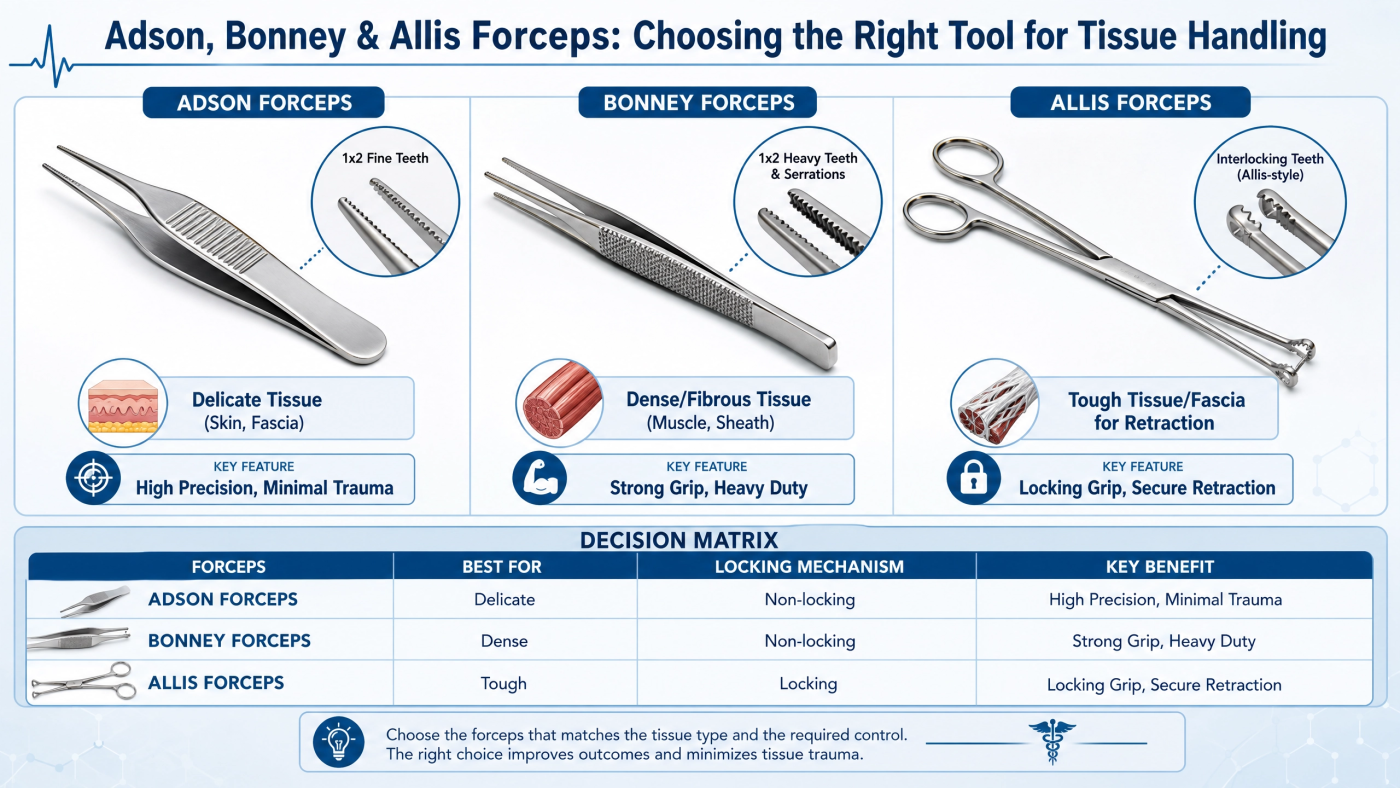
Although these instruments belong to the same family, each one serves a different purpose. Adson forceps provide exceptional precision for delicate tissues. Bonney forceps deliver a stronger grip for dense structures. Meanwhile, Allis forceps secure tissue firmly during retraction and stabilization. Understanding these differences helps clinicians choose the right instrument and achieve better surgical outcomes.
Why Proper Tissue Handling Matters
Successful surgery depends on more than making accurate incisions. Surgeons must also handle tissues carefully throughout the procedure. Excessive pressure or poor instrument selection can damage tissues and slow the healing process.
As a result, improper tissue handling may lead to:
- Increased inflammation
- Delayed wound healing
- Excessive bleeding
- Higher infection risk
- Greater patient discomfort
- Poor cosmetic outcomes
Therefore, selecting the appropriate forceps is essential for maintaining tissue integrity and improving recovery.
Adson Forceps: Precision for Delicate Tissues
When precision becomes the priority, many surgeons reach for Adson forceps. Their compact design and fine tips allow accurate tissue manipulation in confined surgical areas.
Key Features
- Short and lightweight construction
- Fine tapered tips
- Broad thumb grip for better control
- Common 1×2 tooth configuration
- Excellent tactile feedback
Because of these features, Adson forceps help surgeons grasp tissue securely without applying excessive pressure.
Common Applications
Clinicians frequently use Adson forceps in:
- Dental surgery
- Periodontal procedures
- Plastic surgery
- Dermatology treatments
- Wound closure and suturing
Advantages
First, Adson forceps offer exceptional precision. In addition, they reduce tissue trauma by requiring less gripping force. Furthermore, their ergonomic design improves control during delicate procedures.
Limitations
Despite their advantages, Adson forceps do not perform well with thick or fibrous tissues. For that reason, surgeons often select stronger instruments when handling fascia or muscle.
Bonney Forceps: Strength for Dense Tissue
Unlike Adson forceps, Bonney forceps focus on strength rather than delicate precision. Their heavy-duty design allows surgeons to hold tough tissues securely during major procedures.
Key Features
- Robust construction
- Large gripping surface
- Strong interlocking teeth
- Enhanced tissue retention
Consequently, Bonney forceps provide reliable control when surgeons work with dense connective tissues.
Common Applications
Surgeons commonly use Bonney forceps for:
- General surgery
- Abdominal surgery
- Orthopedic procedures
- Fascial closure
- Muscle tissue handling
Advantages
A major benefit of Bonney forceps is their powerful grip. Moreover, they minimize tissue slippage during demanding procedures. As a result, surgeons can maintain better control throughout the operation.
Limitations
However, the aggressive tooth pattern can damage delicate tissues. Therefore, surgeons should avoid using Bonney forceps on fragile structures whenever possible.
Allis Forceps: Secure Tissue Retraction
Allis forceps differ significantly from both Adson and Bonney forceps. Instead of functioning as traditional thumb forceps, they feature finger-ring handles and a locking ratchet mechanism.
Key Features
- Self-retaining design
- Multiple inward-curving teeth
- Locking ratchet mechanism
- Strong tissue-holding capability
Thanks to these characteristics, Allis forceps maintain a secure grip without continuous hand pressure.
Common Applications
Many surgical teams use Allis forceps for:
- Tissue retraction
- Surgical flap stabilization
- Specimen handling
- General surgery
- Soft tissue exposure
Advantages
One significant advantage is hands-free tissue retention. Additionally, the locking mechanism improves surgical efficiency. Furthermore, surgeons can achieve better visibility within the operative field.
Limitations
Even though Allis forceps provide excellent retention, they can cause considerable tissue trauma. Consequently, surgeons typically reserve them for tissues that can tolerate a stronger grip.
Comparing Adson, Bonney, and Allis Forceps
| Feature | Adson Forceps | Bonney Forceps | Allis Forceps |
|---|---|---|---|
| Primary Purpose | Delicate tissue handling | Dense tissue handling | Tissue retraction |
| Grip Strength | Light to moderate | Strong | Very strong |
| Precision | Excellent | Moderate | Moderate |
| Tissue Trauma | Low | Moderate | High |
| Locking Mechanism | No | No | Yes |
| Best Tissue Type | Fragile tissue | Fascia and muscle | Retractable tissue |
| Common Use | Suturing | General surgery | Tissue stabilization |
How to Choose the Right Forceps
The best forceps depend on the tissue type and the surgical objective. Rather than relying on a single instrument, experienced surgeons select forceps according to the demands of the procedure.
For example, Adson forceps work best when precision and tissue preservation matter most. On the other hand, Bonney forceps perform exceptionally well when surgeons need a stronger grip on dense tissues. In contrast, Allis forceps excel during tissue retraction and stabilization.
By matching the instrument to the task, clinicians can improve efficiency while reducing unnecessary tissue damage.
Conclusion
Although Adson, Bonney, and Allis forceps belong to the same category of tissue-handling instruments, each one solves a different surgical challenge. Adson forceps provide precise control for delicate tissues. Bonney forceps deliver the strength required for dense structures. Meanwhile, Allis forceps offer secure tissue retention during retraction and exposure.
Ultimately, choosing the right forceps improves surgical performance, protects tissue integrity, and supports better patient outcomes. Therefore, understanding the strengths and limitations of each instrument remains essential for every surgical professional.