
Stainless Steel vs Titanium Tools: Which Is Better?
Choosing the right material for orthodontic instruments is essential for delivering precise, efficient, and long-lasting patient care. Whether you are purchasing new tools or replacing worn instruments, understanding the differences between stainless steel and titanium can help you make a smarter investment.
Stainless steel orthodontic instruments have been the industry standard for decades because they combine strength, durability, and affordability. Meanwhile, titanium instruments are valued for their lightweight design, exceptional corrosion resistance, and excellent biocompatibility. However, each material has unique strengths that make it suitable for different clinical situations.
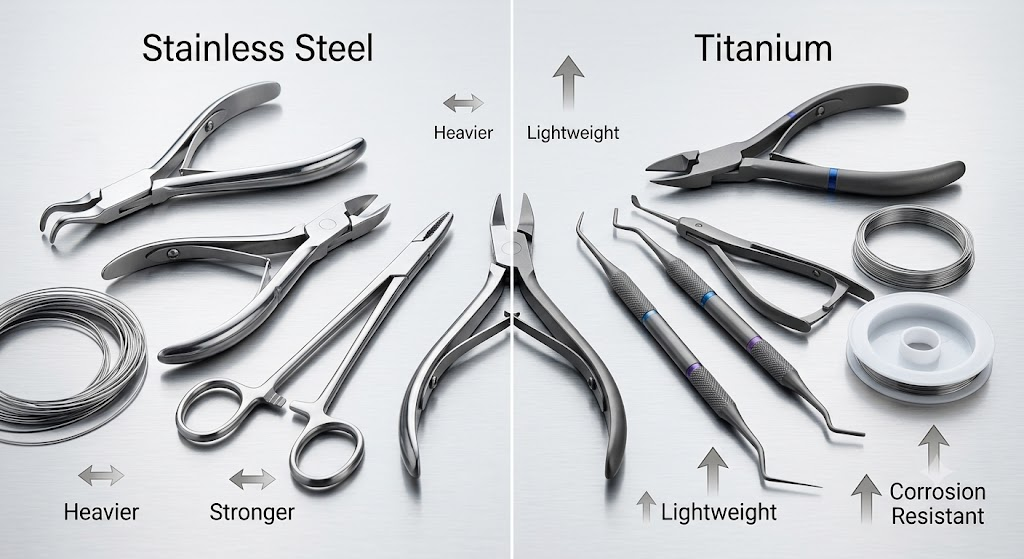
This comprehensive guide compares stainless steel and titanium orthodontic instruments across durability, cutting performance, corrosion resistance, weight, maintenance, and overall value to help you determine which option best suits your orthodontic practice.
Why Does Instrument Material Matter in Orthodontics?
Orthodontic instruments are subjected to demanding conditions every day. For example, they are repeatedly exposed to high-pressure steam sterilization, moisture, cleaning chemicals, and continuous mechanical stress. As a result, the material used in an instrument directly affects its lifespan, precision, and reliability.
A high-quality material helps maintain sharp cutting edges, proper jaw alignment, and corrosion resistance over years of clinical use. On the other hand, poor-quality materials may lead to rust, reduced performance, frequent repairs, and higher replacement costs.
Therefore, selecting premium orthodontic instruments is an investment in both clinical efficiency and patient satisfaction.
What Are Stainless Steel Orthodontic Instruments?
Stainless steel orthodontic instruments are manufactured from surgical-grade stainless steel, typically using alloys such as AISI 420, AISI 440A, or AISI 440C. These alloys are specifically engineered to provide an excellent combination of hardness, wear resistance, and corrosion protection.
In addition, stainless steel can be heat-treated to improve its strength and edge retention, making it ideal for orthodontic procedures that require precision and durability.
Common stainless steel orthodontic instruments include:
- Distal End Cutters
- Ligature Cutters
- Bird Beak Pliers
- Weingart Pliers
- Utility Pliers
- Bracket Removing Pliers
- Band Removing Pliers
- Mathieu Needle Holders
- Three-Prong Pliers
Because of their excellent performance and cost-effectiveness, stainless steel instruments remain the preferred choice in most orthodontic clinics worldwide.
What Are Titanium Orthodontic Instruments?
Titanium orthodontic instruments are manufactured using commercially pure titanium or advanced titanium alloys. These materials are widely recognized for their exceptional corrosion resistance and lightweight construction.
Furthermore, titanium naturally develops a protective oxide layer that shields the surface from corrosion, even after repeated sterilization cycles.
Titanium instruments are commonly used for:
- Implant-related procedures
- Microsurgical instruments
- Specialty orthodontic tools
- Titanium-coated instrument tips
Although titanium instruments offer several advantages, they are generally more expensive than stainless steel alternatives.
Stainless Steel vs Titanium Tools: Feature Comparison
| Feature | Stainless Steel Orthodontic Instruments | Titanium Orthodontic Instruments |
|---|---|---|
| Durability | Excellent | Very Good |
| Hardness | Excellent | Good |
| Weight | Heavier | Lightweight |
| Cutting Performance | Excellent | Good |
| Corrosion Resistance | Excellent | Outstanding |
| Sterilization Compatibility | Excellent | Excellent |
| Cost | Affordable | Premium |
| Wear Resistance | Excellent | Good |
| Precision | Excellent | Excellent |
| Longevity | Excellent | Excellent |
1. Strength and Durability
First, durability is one of the most important factors when selecting orthodontic instruments. Daily procedures involve cutting wires, bending archwires, removing brackets, and gripping small components.
Consequently, instruments must withstand repeated mechanical stress without losing their alignment or sharpness.
Stainless steel generally offers greater hardness than titanium, allowing cutting edges to remain sharper for longer. However, titanium is comparatively softer, making it less suitable for heavy cutting applications unless reinforced with specialized coatings.
Winner: Stainless Steel
2. Weight and Handling
Another important consideration is instrument weight.
Titanium is approximately 40–45% lighter than stainless steel. As a result, clinicians often experience less hand fatigue during lengthy procedures.
Additional benefits include:
- Improved comfort
- Better maneuverability
- Reduced wrist strain
- Enhanced precision during delicate procedures
Nevertheless, many orthodontists prefer the balanced feel of stainless steel instruments for routine clinical work.
Winner: Titanium
3. Corrosion Resistance
Corrosion resistance is essential because orthodontic instruments undergo frequent sterilization.
Moreover, titanium naturally forms a protective oxide layer that provides outstanding resistance against moisture and chemicals.
Likewise, high-quality surgical stainless steel offers excellent corrosion resistance when instruments are cleaned, dried, and sterilized correctly.
Overall, both materials perform exceptionally well in modern orthodontic practices.
Slight Winner: Titanium
4. Cutting Performance
Orthodontic wire cutting demands exceptional hardness and edge retention.
To achieve consistent results, cutting instruments must resist wear and deformation over thousands of procedures.
Consequently, stainless steel performs exceptionally well because it can be heat-treated to achieve superior hardness. Many premium orthodontic cutters even incorporate hardened stainless steel inserts to maximize cutting efficiency.
In contrast, titanium is generally less effective for repeated heavy-duty cutting applications.
Winner: Stainless Steel
5. Precision During Orthodontic Procedures
Precision is essential for accurate bracket placement, wire adjustments, and ligature handling.
Both materials can be manufactured to extremely high standards. However, stainless steel typically maintains jaw alignment and gripping accuracy longer under continuous clinical use.
Therefore, it remains the preferred material for instruments requiring consistent precision.
6. Sterilization Performance
Proper sterilization protects both patients and clinicians.
Fortunately, stainless steel and titanium are fully compatible with steam autoclaves, ultrasonic cleaning systems, and approved chemical disinfectants.
Additionally, neither material experiences significant degradation when sterilization protocols are followed correctly.
With proper maintenance, either material can provide many years of dependable service.
7. Cost Comparison
Another important factor to consider is overall cost.
Stainless steel instruments offer outstanding value because they combine excellent durability with relatively low manufacturing costs.
Titanium instruments, by comparison, require more complex manufacturing processes and higher-quality raw materials. Consequently, they are significantly more expensive.
Therefore, stainless steel remains the more economical choice for most orthodontic practices.
8. Longevity
Long-lasting instruments reduce replacement costs and improve operational efficiency.
To maximize instrument lifespan, clinicians should:
- Clean instruments immediately after use.
- Remove all debris before sterilization.
- Dry instruments thoroughly.
- Lubricate hinged instruments regularly.
- Inspect cutting edges for wear.
- Store instruments in protective cassettes.
By following these maintenance practices, both stainless steel and titanium instruments can deliver reliable performance for many years.
Advantages of Stainless Steel Orthodontic Instruments
- Excellent hardness
- Superior cutting performance
- Outstanding durability
- Cost-effective investment
- Easy maintenance
- Excellent wear resistance
- Widely available
- Ideal for daily orthodontic procedures
Advantages of Titanium Orthodontic Instruments
- Lightweight construction
- Exceptional corrosion resistance
- Excellent biocompatibility
- Comfortable during prolonged procedures
- Non-magnetic properties
- High resistance to chemicals
When Should You Choose Stainless Steel?
Stainless steel orthodontic instruments are the ideal choice if your practice requires:
- Daily orthodontic procedures
- Frequent wire cutting
- Reliable gripping performance
- Long-lasting cutting edges
- Excellent value for money
- Durable orthodontic pliers
For most clinics, stainless steel continues to deliver the best combination of performance and affordability.
When Should You Choose Titanium?
Titanium instruments are better suited for situations requiring:
- Lightweight handling
- Microsurgical procedures
- Implant-related treatments
- Maximum corrosion resistance
- Reduced operator fatigue
Although titanium excels in these specialized applications, it is less commonly used for routine heavy-duty orthodontic work.
Final Verdict
Ultimately, both stainless steel and titanium orthodontic instruments offer excellent clinical performance. However, the right choice depends on your specific clinical requirements and budget.
Stainless steel orthodontic instruments remain the preferred option for most orthodontic practices because they provide outstanding durability, superior cutting performance, excellent wear resistance, and exceptional value. In contrast, titanium instruments excel when lightweight construction, enhanced corrosion resistance, or specialized surgical applications are the priority.
Therefore, if you are looking for reliable, long-lasting, and cost-effective orthodontic instruments for everyday clinical use, stainless steel remains the industry benchmark.
Frequently Asked Questions
Is stainless steel stronger than titanium for orthodontic instruments?
Yes. Surgical-grade stainless steel is generally harder than titanium, making it better suited for cutting, gripping, and other high-stress orthodontic procedures.
Do titanium orthodontic instruments rust?
No. Titanium naturally forms a protective oxide layer that provides exceptional resistance to corrosion under normal clinical conditions.
Which material lasts longer?
Both materials have excellent longevity when properly maintained. However, stainless steel often retains its cutting performance longer in high-use orthodontic environments.
Why are titanium instruments more expensive?
Titanium is more expensive because its raw material costs are higher, and manufacturing requires specialized machining processes.
Which material is best for orthodontic pliers?
Most orthodontic pliers are made from hardened stainless steel because it offers superior strength, edge retention, and long-term durability.